







Node.js 27 regression testing should start with the promise behind an assertion. A changed internal trace is different from a changed customer result. We ran twelve predeclared teaching cases on two pinned official builds and retained all 24 observations, including four expected implementation-snapshot differences.
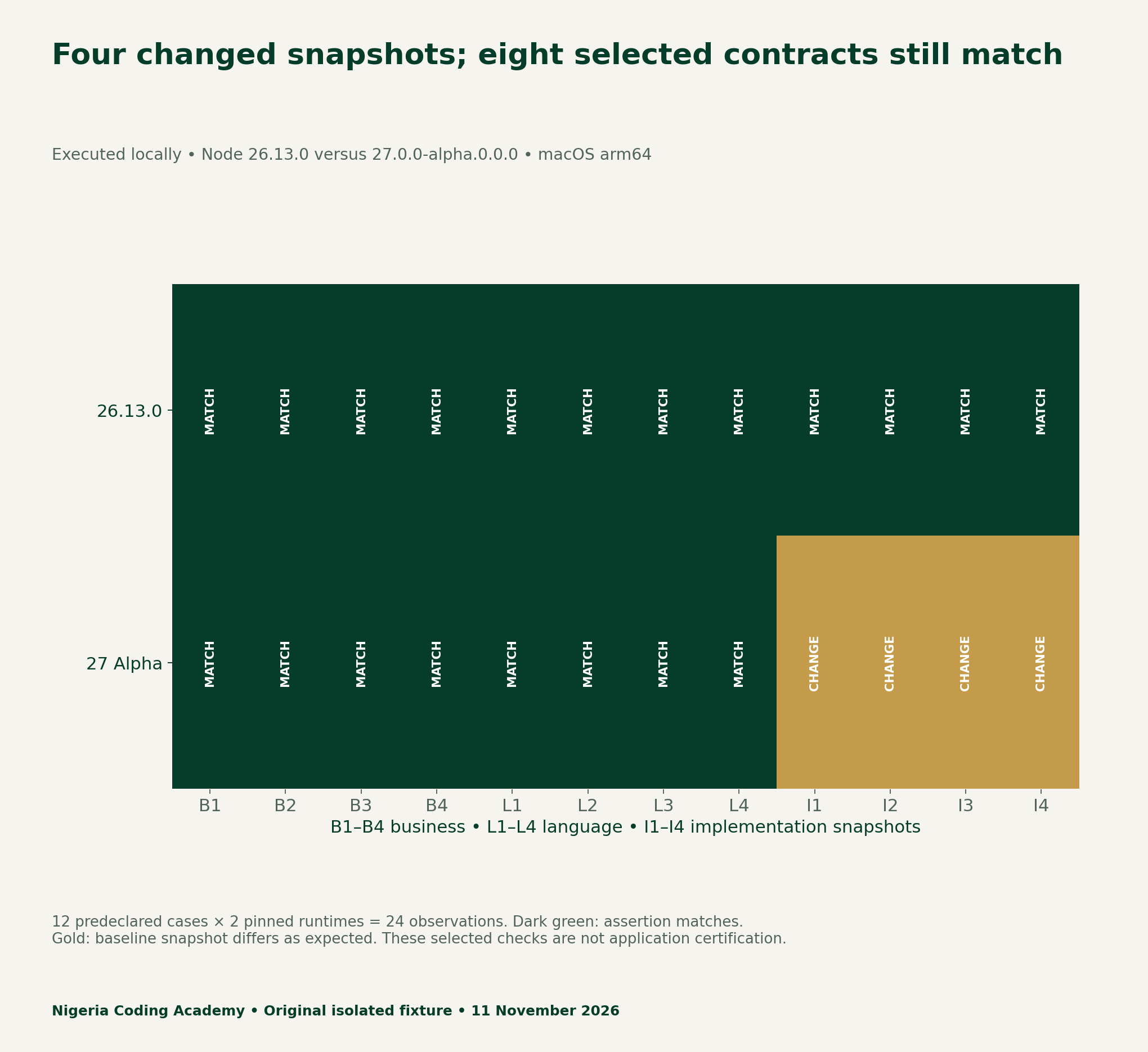
The baseline was Node 26.13.0; the candidate was 27.0.0-alpha.0.0.0. Both ran locally on macOS arm64 in separate processes. Eight selected business and language checks matched on each build. Four deliberately brittle baseline snapshots matched on the baseline and changed on the alpha. This is a small reproducible exercise, not proof that an application is compatible.
Why Node.js 27 regression testing needs a taxonomy
The Node.js team’s 5 November V8 explanation describes the move from V8 14.6 to 15.6. Its sorting, mathematical and seeded-random examples show why tests can change while an intended result remains valid. We used those topics to design a declared assertion taxonomy rather than treating every difference as the same kind of failure.
The 27 Alpha release notice documents an early candidate with observable changes. An alpha can change again. Keep supported production-runtime policy separate from this isolated experiment, and check native add-ons and deployment constraints in an appropriate project audit. Our fixture does not test them.
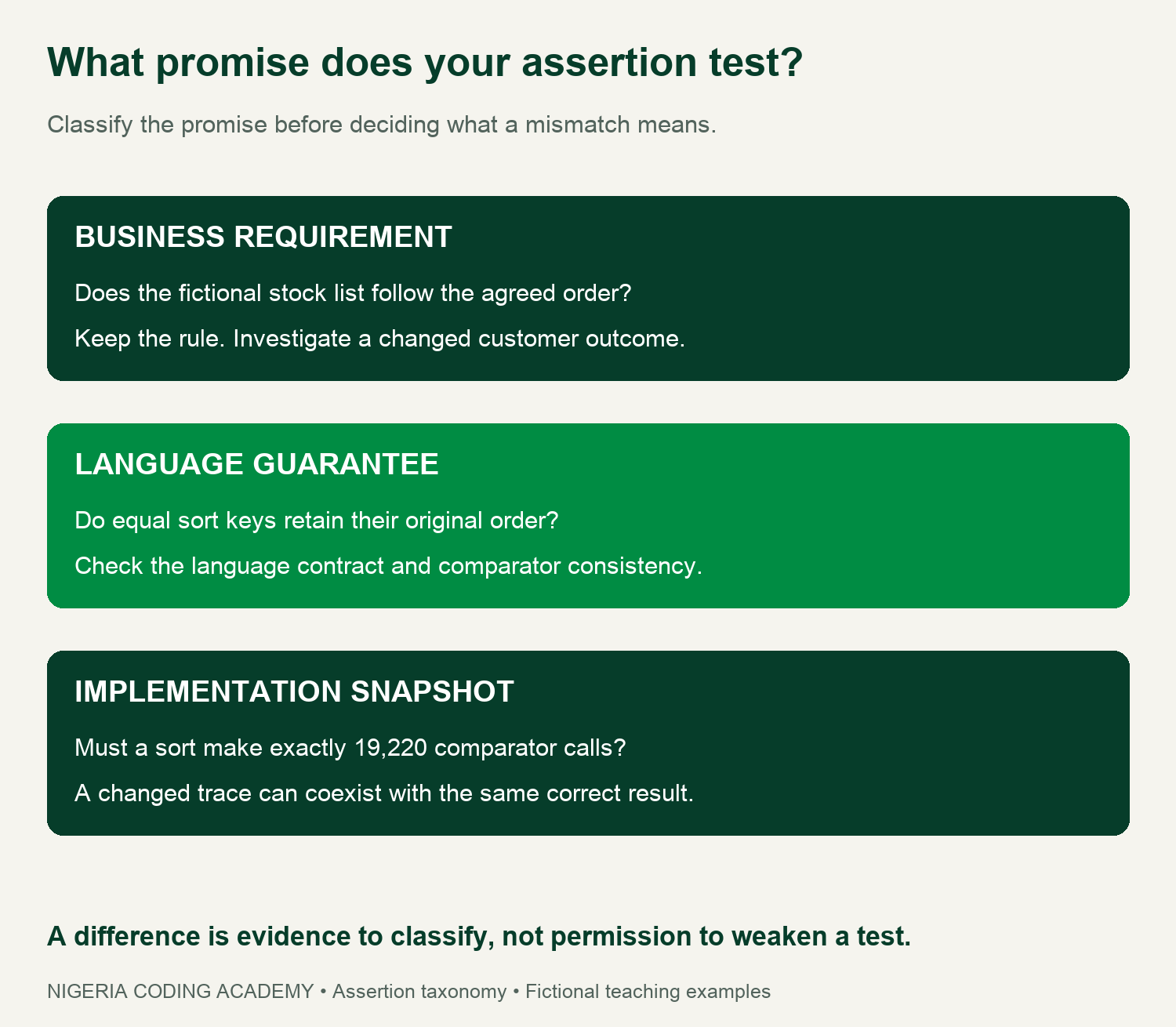
For a Nigerian classroom or portfolio project, ask a concrete question before running anything. Must stock appear in ascending order? Must equal school marks retain their input order? Or did an old test accidentally promise a particular comparator-call count? These are three different contracts, even when the same sort operation appears in each test.
Pin the environments before comparing outputs
We downloaded the two official Darwin arm64 archives, checked each archive against its official SHA-256 listing and ran them from an isolated temporary directory. We did not replace the system Node installation. The retained source register records the vendor URLs and checksums, while the observation CSV records runtime, V8, architecture, platform and execution flags.
Each of the twelve cases ran in a fresh process with the same random-seed flag. That matters because an earlier random call would consume part of a sequence. We kept the fixture inputs and expected assertions fixed before execution. No package installation, network request, real learner record or production service was involved in the test run.
The matrix has twelve cases multiplied by two runtimes: 24 planned observations and 24 executed observations. That is complete coverage of this selected fixture only. It is not a percentage of an application, all JavaScript behaviour or all possible inputs. A small denominator must stay visible even when every planned row has a result.
Four fictional business requirements
B1 orders three fictional stock records by quantity. B2 sums three small integer kobo amounts to 25,249 kobo. B3 bounds three fictional marks to the chosen zero-to-100 interval. B4 checks an application-owned teaching pseudorandom generator with explicit integer arithmetic. All four produce the expected result on both pinned builds.
These examples make the requirement inspectable. The kobo calculation deliberately avoids fractional naira arithmetic, and its small sum remains a safe JavaScript integer. It is not a complete accounting implementation. Likewise, the teaching generator is reproducible because its algorithm belongs to the fixture; it is unsuitable for passwords, security tokens or other cryptographic use.
A changed business result would need investigation even if an engine upgrade were expected to change internal behaviour. Keep the fixture, expected outcome and reason together. Do not change the expected stock order merely because a new runtime returns something else, and do not describe a green classroom example as validation of an unrelated shop.
Four selected language checks
L1 checks relative order for equal marks. L2 checks ascending output for the deterministic 2,000-element numeric input. L3 checks a short numeric list containing a duplicate. L4 checks that 100 sampled random values are within the required range. These selected assertions match on both builds; the samples do not establish a randomness-quality result.
The ECMAScript sorting specification distinguishes a consistent comparator and stable ordering from an engine’s internal sequence of comparisons. Returning contradictory results or relying on side effects in a comparator can undermine the intended test. Write the comparator around the ordering relation, and test the resulting order and retained elements.
Four baseline snapshots that changed
I1 records a fixed comparator-call count. I2 and I3 compare the last bits of two mathematical outputs with exact baseline constants. I4 compares the first engine-generated random value under a fixed seed. Each is intentionally a snapshot of incidental behaviour. All four match Node 26.13.0 and differ on the chosen alpha build in our local execution.
The comparator case records 19,220 calls on the baseline and 19,249 on the alpha, a difference of 29. Dividing 29 by 19,220 gives about 0.151% more calls for this input. We collected no elapsed-time data. A count difference does not establish a speed regression, CPU cost, energy change or user-visible delay.
Unlock Your Unique Tech Path
Get expert tech consulting tailored just for you. Receive personalized advice and solutions within 1-3 business days.
Get Started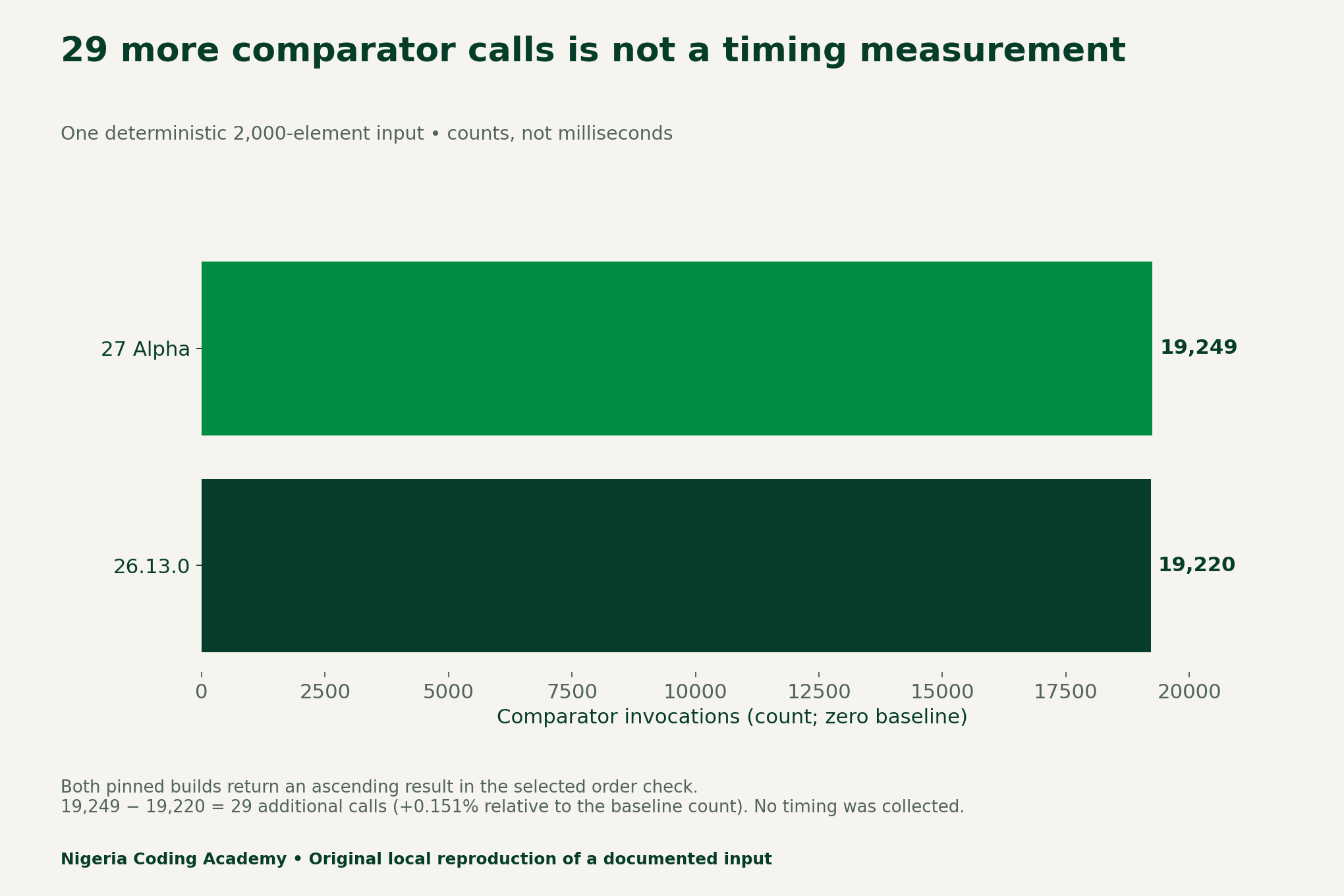
The retained numerical outputs differ in their final bits, and the seeded engine-random outputs differ more visibly. Those values are observations from these builds and this platform. The fixture does not promise that another build or platform will repeat every number. Its useful result is the distinction between an explicit requirement and an accidental snapshot.
Choose a numerical policy before running the candidate
Some domains require exact integer or decimal rules. Others permit a justified absolute or relative error. Define the applicable unit, scale and acceptable error before testing; record the owner of that decision. An unexplained tolerance that grows until a test passes can conceal a real regression.
Our mathematical snapshot cases intentionally use exact equality to expose brittle assumptions. We do not relabel them as acceptable approximate results under a newly invented tolerance. A project-specific numerical audit should add independently justified checks, keep the old result and document why its policy is appropriate for the calculation.
For related work, see our WAL forecast fixture, which keeps units and missing states visible, and our synthetic masking study, which separates a narrow relationship check from a broader safety claim. The same evidence discipline applies to runtime tests.
Download the twelve-case kit and record your own run
The original Node assertion fixture (ZIP) includes the JavaScript cases, Python runner, README and retained observations. Supply your own pinned official Node binaries to the runner. It makes no network calls. Read the case definitions before execution and keep candidate runtimes away from production and private data.
- Twenty-four raw runtime observations (CSV)
- Twelve-case assertion taxonomy (CSV)
- Baseline and alpha comparison (CSV)
- Blank project regression register (CSV)
Method, limitations and citation
Research and local execution checked 11 November 2026. We retained official release sources and checksums, then executed one deterministic case per process on each of two pinned builds. The result is 24 observations, not a representative sample of Nigerian applications. We did not measure performance, production reliability, dependency compatibility or native add-on behaviour.
Suggested citation: Nigeria Coding Academy, “Node.js 27 Regression Testing: Contracts Before Snapshots,” 11 November 2026. Cite Node.js for its release documentation and this report for the declared fixture and local observations. Send evidence-backed corrections through our contact page.


