




Google Pay Nigeria integration needs evidence at several layers. A payment sheet can open while an order still awaits confirmation. This guide explains that boundary and provides a six-case local checkout exercise, an event ledger and downloadable testing tools.
Research date: 1 November 2026. We reviewed Google’s launch announcement and developer documentation, then ran a fictional Python order ledger. All six selected cases met their expectations. We made zero Google API calls, zero gateway calls and zero live charges. These are local mock results, not results from Google’s TEST environment.
What Google announced in Nigeria
Google’s 28 October 2026 Nigeria announcement says Google Wallet, including Google Pay, is available for Android and Wear OS users. It describes payments with supported cards from participating financial institutions. The statement does not establish support for every Nigerian card, merchant or gateway.
Therefore, begin with a precise project question: which checkout configuration are you testing? Record the merchant, processor, supported methods, browser and environment before drawing conclusions. This article does not rank banks or recommend moving money. Its purpose is to help a coding learner describe a demonstration honestly.
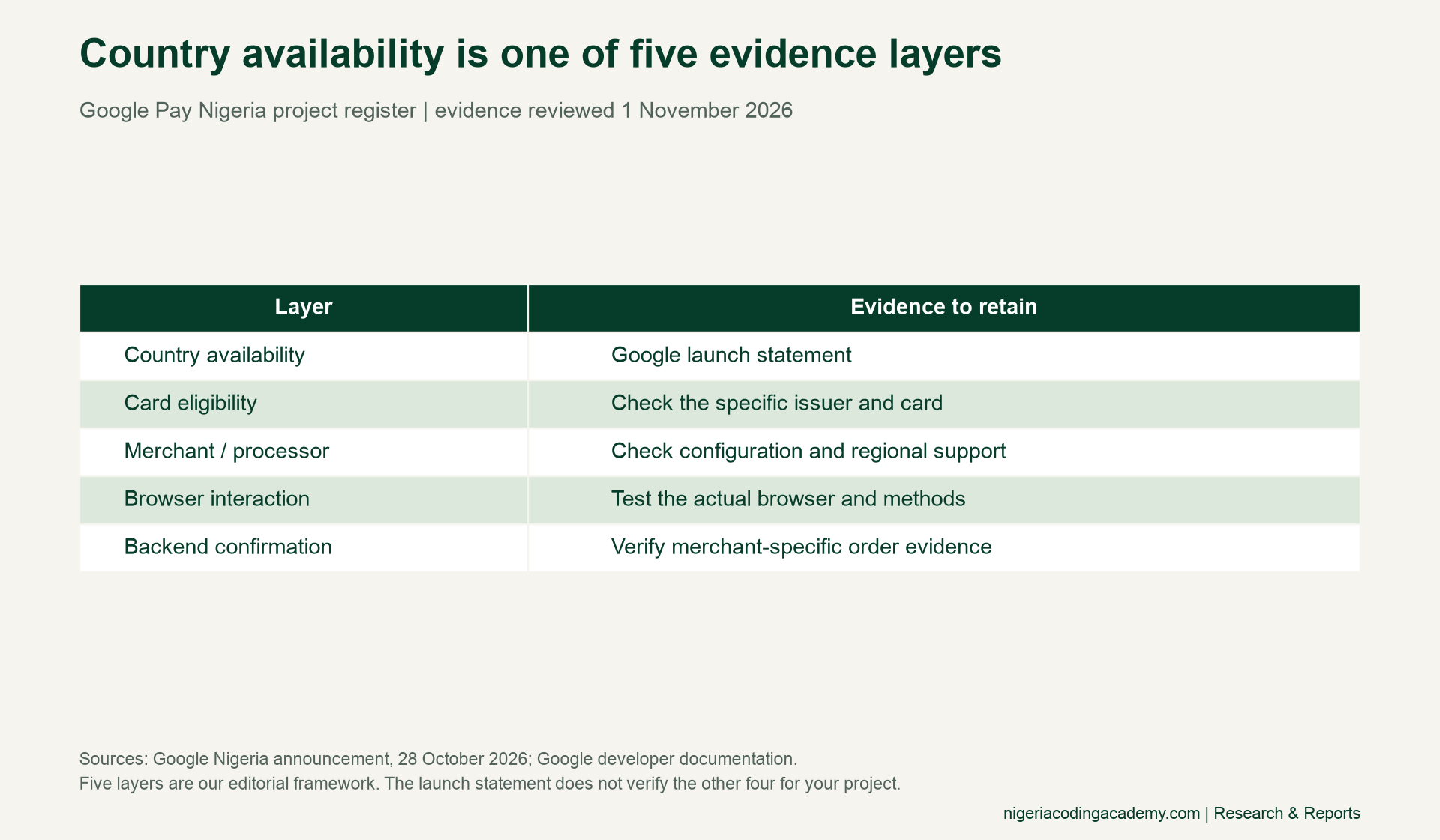
Separate five Google Pay Nigeria evidence layers
Our five-layer framework separates country availability, card eligibility, merchant configuration, browser interaction and backend confirmation. The layer count is an editorial design choice, not a Google certification standard. A verified statement at one layer leaves the others to be checked for your project.
First, retain the country announcement. Next, consult current issuer information for the exact card. Then check the processor’s regional support and merchant configuration. Finally, test the browser journey and the evidence that changes the order’s state. Mark an unresolved dependency as unknown instead of filling it with an assumption.
The same evidence discipline appears in our postcode app data-contract study. A source-status register helps another developer distinguish an official statement, a local assumption and an executed test. Keep those categories visible in your checkout project too.
Google TEST and a local mock provide different evidence
Google’s integration checklist says TEST configuration does not return live, chargeable payment information. It can support checks of parts of the purchase workflow. The checklist also requires checking processor-supported networks and authentication methods and confirming readiness before displaying the payment button.
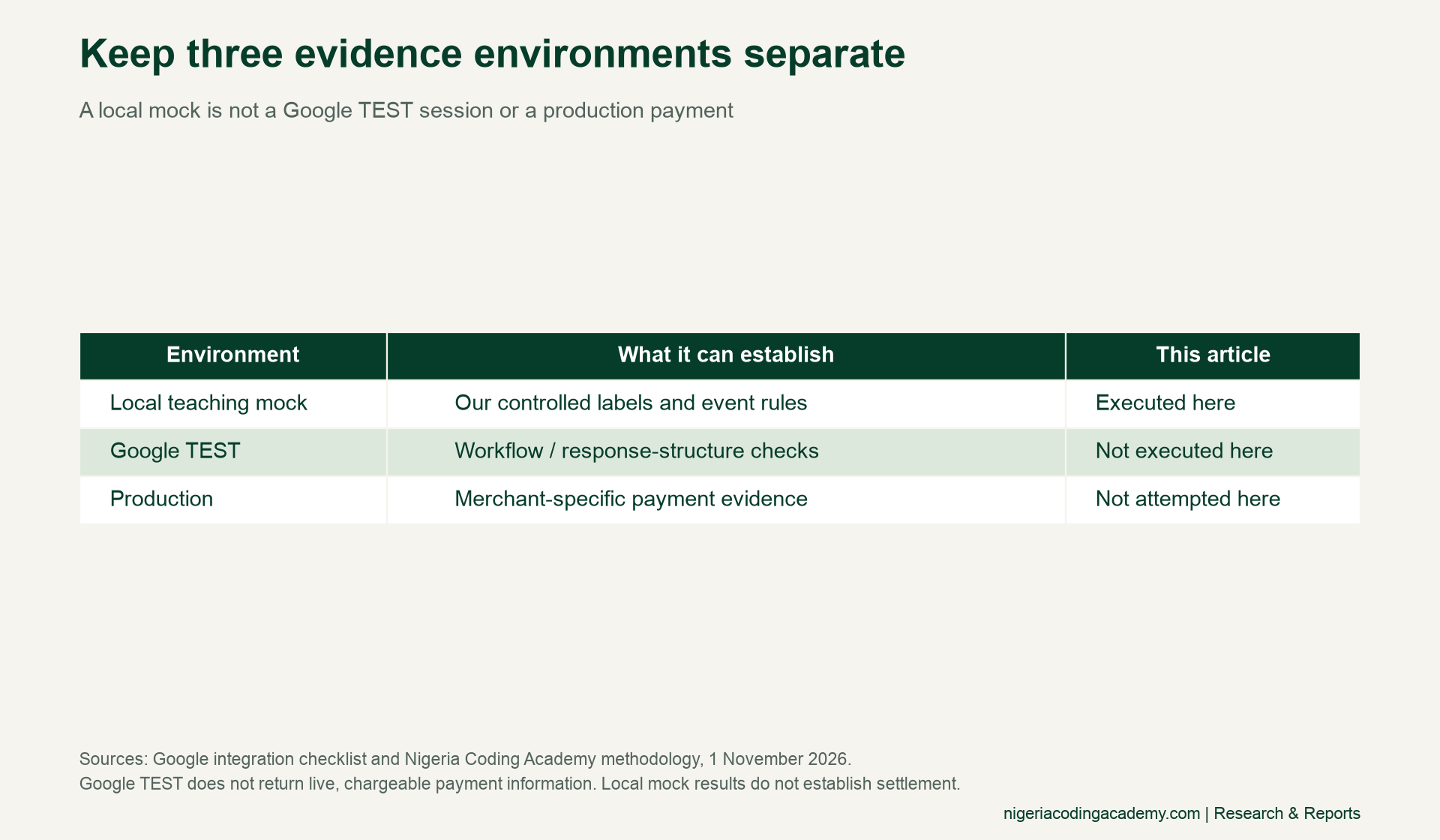
Our exercise sits one step earlier: it is a local mock written entirely for this article. It tests how a fictional order responds to selected events. It does not open a Google payment sheet, return a Google response or communicate with a processor. Consequently, its passing checks cannot establish card compatibility or settlement.
Google’s web tutorial illustrates API version 2.0 and the authentication methods PAN_ONLY and CRYPTOGRAM_3DS. It asks developers to confirm regional device-token support with their processor and acquirer. These are documented interface options, rather than Nigerian market-share figures or a promise that either method works for your merchant.

Run six fictional checkout cases
We chose six cases: readiness false, cancellation, a payment-data response, simulated rejection, delayed confirmation and duplicate confirmation. Each case has a specified expected state and mock fulfilment count. The Python ledger then records the actual state after every event.
For clarity, paid_in_mock is only a label in this exercise. A simulated confirmation is an input we control. It is not evidence that a bank approved a charge, a processor settled funds or a real customer paid. Likewise, awaiting_confirmation is our teaching state, not an official Google response status.
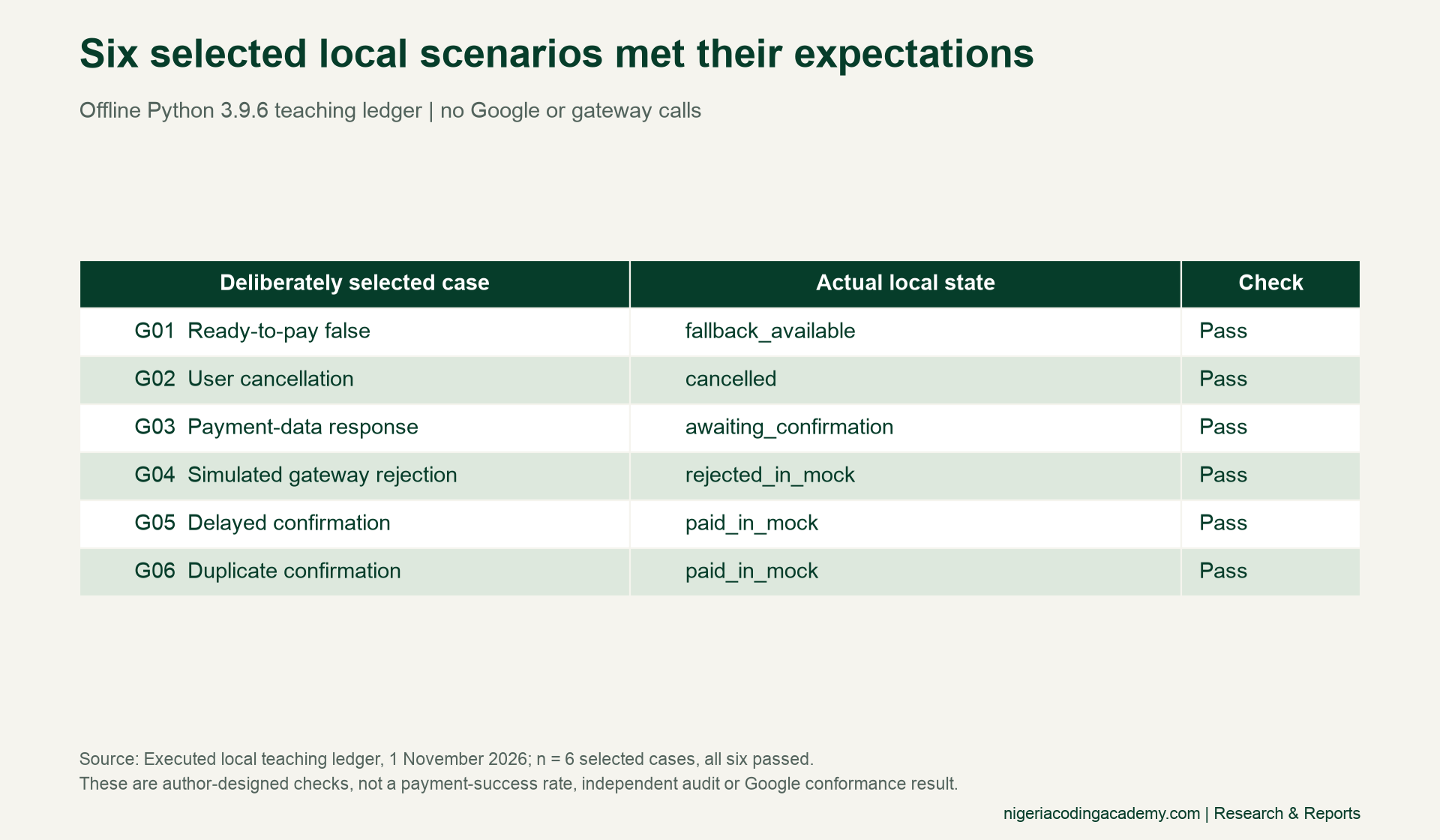
Our recorded run used Python 3.9.6 on macOS with an arm64 processor. The six cases produced 11 event observations. All six checks matched both their expected final state and their expected mock fulfilment count. There were no network calls or personal payment details.
These six selected checks are not a payment-success rate. We wrote the small model and its expectations, so the result is an inspectable teaching exercise rather than independent validation. A real implementation needs a broader test plan, supported configuration and review of its own requirements.
Keep duplicate confirmation from duplicating fulfilment
Case G06 delivers the same fictional confirmation ID twice. The ledger remembers that ID, so its fulfilment count remains one. This illustrates idempotency: repeating the selected event does not repeat the chosen effect. It does not prove a real system handles retries or concurrent requests safely.
Unlock Your Unique Tech Path
Get expert tech consulting tailored just for you. Receive personalized advice and solutions within 1-3 business days.
Get Started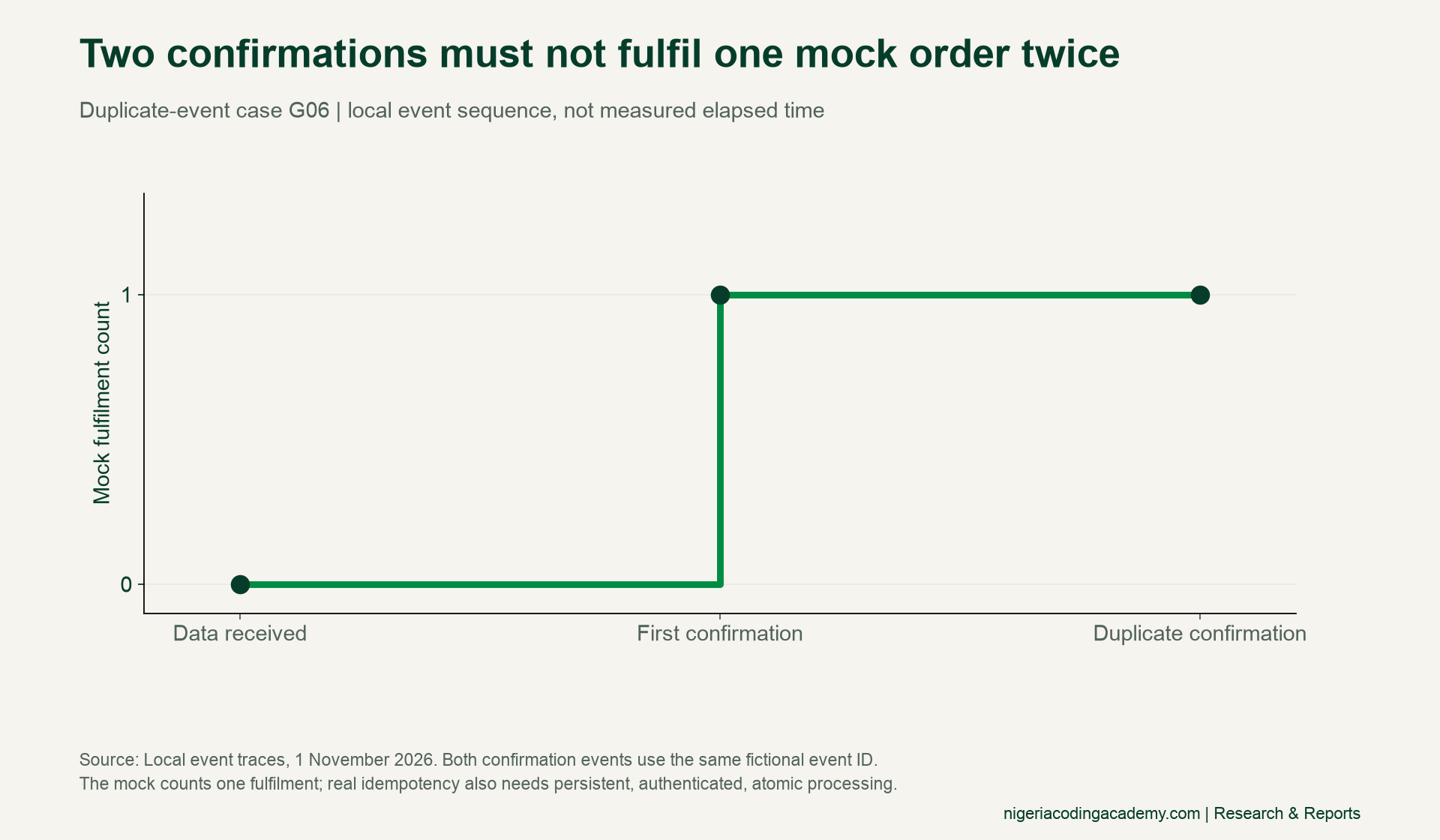
An in-memory set is enough for this toy model, but a process restart would lose it. Production handling requires the merchant’s actual contract, authenticated evidence, persistent storage and atomic processing. It must also handle matters such as rejected, out-of-order and conflicting events. None of those production controls was implemented or audited here.
For each additional case, specify the expected result before running it. Keep a record of the code revision and fixture version. Our version-control guide can help you retain that history. This makes a changed result easier for another developer to investigate.
A callback should not erase the pending state
Case G03 stops after the fictional payment-data event. Its final state remains awaiting_confirmation, with zero mock fulfilments. Case G05 inserts a wait before a simulated confirmation; the order stays pending during that wait. Neither case uses a measured payment delay.
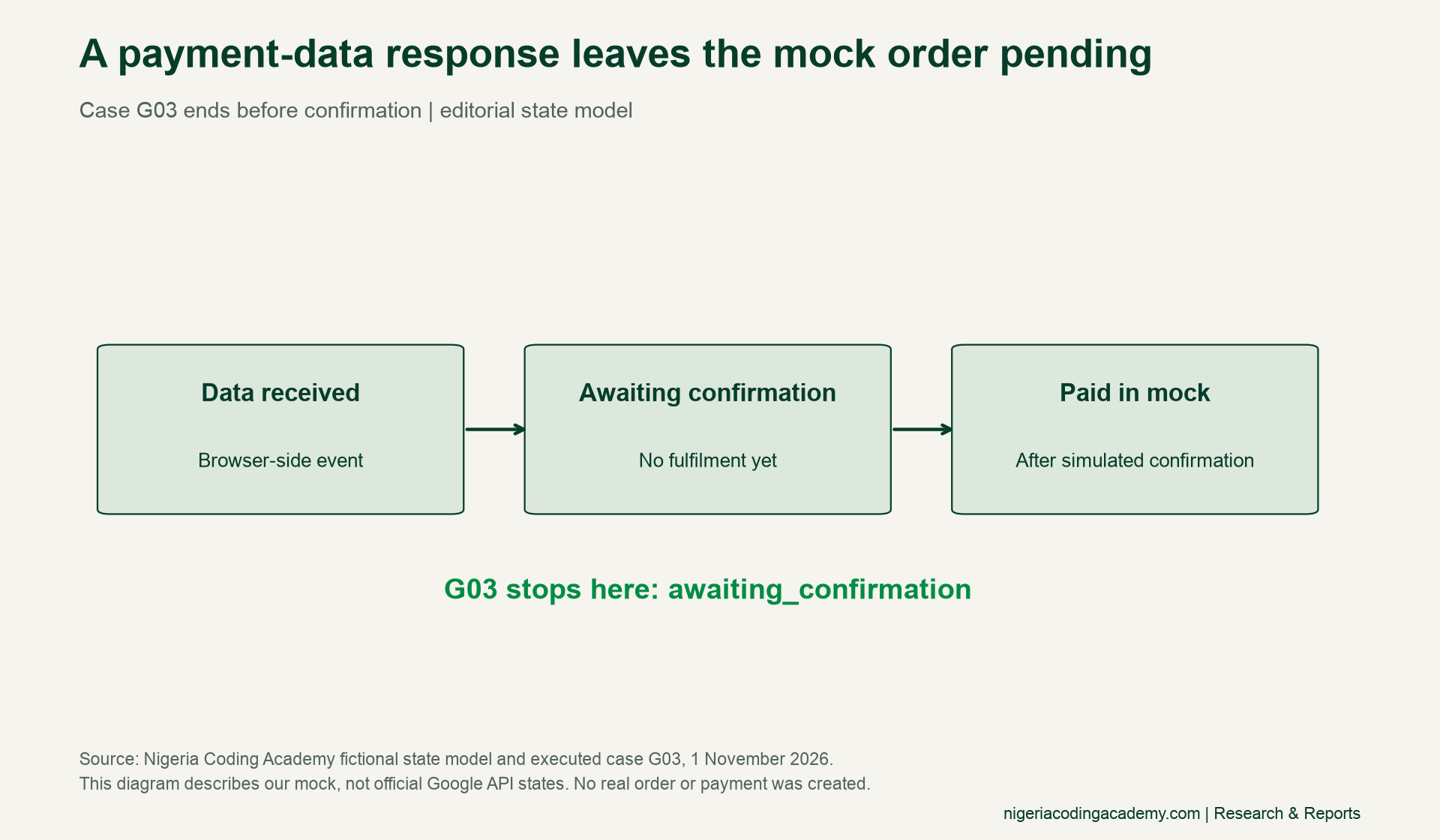
This distinction helps a learner test the interface text. Show a clear pending message while the required evidence is missing. Offer an appropriate fallback when readiness is false. Keep cancellation separate from rejection, and avoid telling the user to submit the same order again without checking what happened.
Reproduce the local ledger
Run the following example locally with Python 3. It uses only fictional event IDs and deliberately simple rules. It is not a payment SDK, a webhook handler or production checkout code. Do not connect it to live credentials or use its labels to fulfil real orders.
def simulate(events):
 state='created';seen=set();fulfilments=0;trace=[]
 for step,event in enumerate(events,1):
  kind,event_id=event
  if kind=='ready_false':state='fallback_available'
  elif kind=='cancel':state='cancelled'
  elif kind=='data':state='awaiting_confirmation'
  elif kind=='reject':state='rejected_in_mock'
  elif kind=='wait':pass
  elif kind=='confirm' and event_id not in seen:
   seen.add(event_id);state='paid_in_mock';fulfilments+=1
  trace.append({'step':step,'event':kind,'event_id':event_id,'state':state,'mock_fulfilment_count':fulfilments})
 return state,fulfilments,trace
fixtures=[
 ('G01','Ready-to-pay false',[('ready_false','')],'fallback_available',0),
 ('G02','User cancellation',[('cancel','')],'cancelled',0),
 ('G03','Payment-data response',[('data','')],'awaiting_confirmation',0),
 ('G04','Simulated gateway rejection',[('data',''),('reject','')],'rejected_in_mock',0),
 ('G05','Delayed confirmation',[('data',''),('wait',''),('confirm','MOCK_EVENT_1')],'paid_in_mock',1),
 ('G06','Duplicate confirmation',[('data',''),('confirm','MOCK_EVENT_2'),('confirm','MOCK_EVENT_2')],'paid_in_mock',1),
]
for case, condition, events, expected, expected_count in fixtures:
 state, count, trace = simulate(events)
 passed = state == expected and count == expected_count
 print(case, state, count, passed)
Compare the printed output with the populated results file. Then adapt the blank ledger for your own controlled exercise. Label every row with its actual environment. A local mock row must not be relabelled as Google TEST merely because both environments avoid live charges.
Download the evidence and test tools
- Five-layer dependency register (CSV): evidence requirements, sources, status and caveats.
- Executed local ledger results (CSV): six cases, expected and actual states, fulfilment counts and checks.
- Local event traces (CSV): 11 case-step observations with fictional event IDs and state changes.
- Blank checkout test ledger (CSV): expected state, actual state, environment, configuration, timestamp and redacted evidence reference.
Open the files as UTF-8 and preserve their case identifiers. Blank actual-result cells mean no result has been recorded. Keep tokens, card details, customer records and private merchant documents out of published logs. A useful portfolio needs inspectable evidence, not sensitive payment data.
Methodology and next steps for Google Pay Nigeria projects
We used Google’s 28 October launch statement as the news source and its web documentation as technical context. Our original contribution is the five-layer evidence register and executed fictional order ledger. The six fixtures were selected for instruction, without random sampling, Nigerian transaction data or representative failure rates.
Before a real integration, verify current issuer, processor, merchant and regional requirements directly. Follow Google’s complete official checklist for a supported TEST configuration and any later deployment. This article does not grant production access, certify security or establish fraud resistance, settlement, universal compatibility or commercial readiness.
Suggested citation: Nigeria Coding Academy, “Google Pay Nigeria Integration: A Test-Mode Checkout Evidence Checklist,” 1 November 2026. Cite the relevant figure or CSV with its environment and denominator. Our original fictional fixtures and worksheets may be reused with attribution under CC BY 4.0; Google’s material remains subject to its own terms. The featured and inside images are AI-generated conceptual illustrations, not screenshots of a tested payment service.


