




A useful Nigeria postcode app starts with a documented data contract: the rules that explain what a service accepts, returns and permits. A map pin alone cannot supply that evidence. Our six-case fictional exercise shows how a learner can test uncertainty before connecting to an authorised service.
Research date: 1 November 2026. We reviewed official guidance and ran a small offline Python adapter. All six chosen checks matched their expected states. However, this exercise made zero official postcode API calls. It does not measure national coverage, delivery success or production readiness.
What the five postcode demonstrations establish
FMCIDE published its inaugural postcode pitch announcement on 28 October 2026. It describes the session as taking place the previous day, placing it on 27 October. Five builders presented: Topship, Ọ̀nà, Buildocrat, Hospify and Electra.
The ministry announced further sessions for 7 and 21 November, both at 12 noon WAT. These dates are scheduled opportunities. They do not guarantee admission, integration access or a partnership. The five presentations count demonstrations, rather than customers, completed deliveries or transactions.
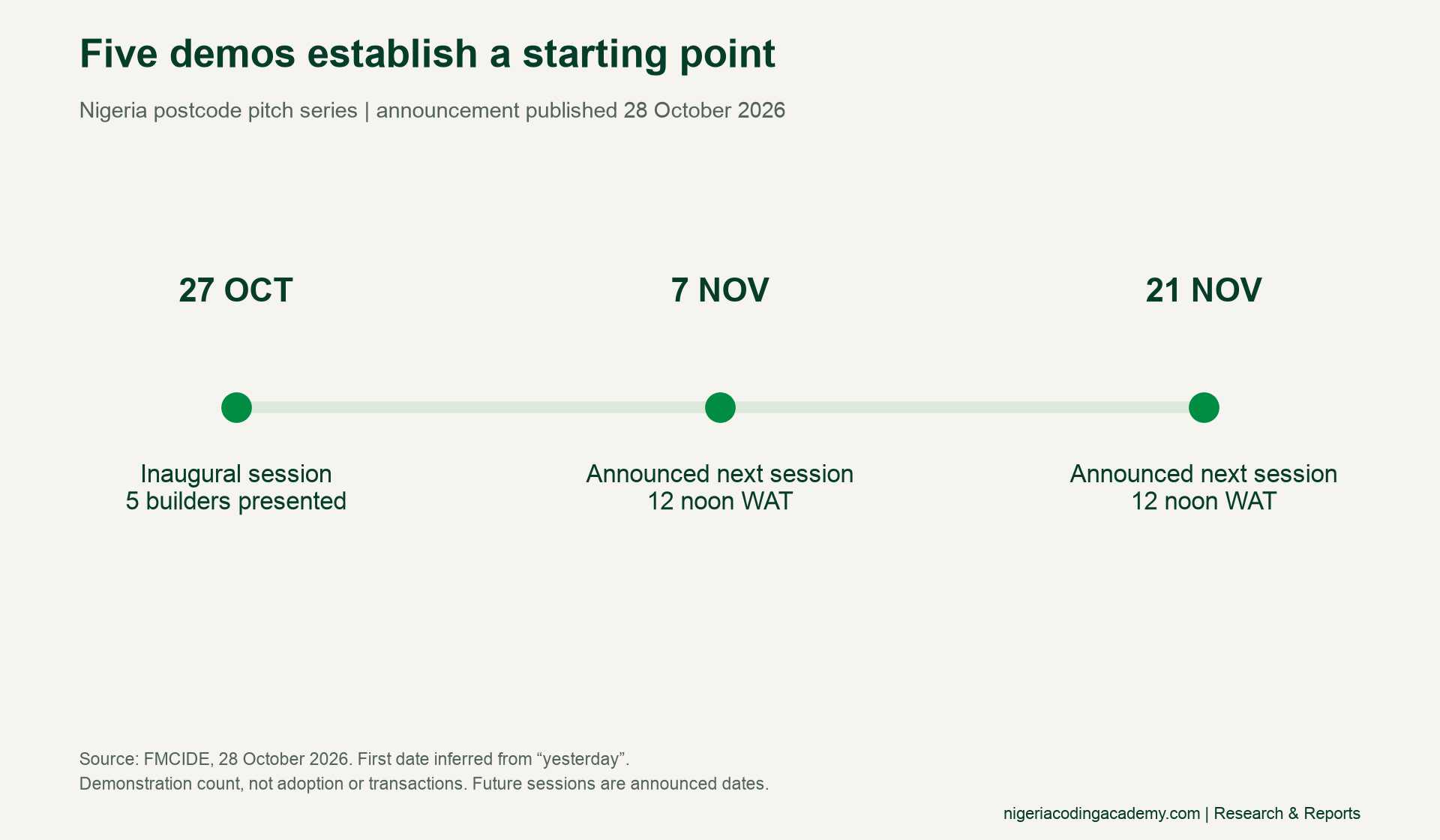
The announcement gives learners a timely project context. Yet it does not provide the interface schema, reuse licence or measured delivery improvements needed to substantiate a working integration. A classroom team should identify those gaps before promising results.
Build a Nigeria postcode app evidence register
A data contract should let another developer reproduce your assumptions. First, record the exact source, retrieval date and version for each requirement. Then identify what remains unresolved and who will check it. Our register reviews six questions against the ministry announcement only.
- Interface: Where are the versioned request and response definitions?
- Identifiers: Which authoritative rules govern accepted values?
- Permitted use: What licence or permission covers your project?
- Updates: How do corrections, versions and cached records change?
- Authentication: Which approved access method applies?
- Errors: How does the service distinguish failure, absence and ambiguity?
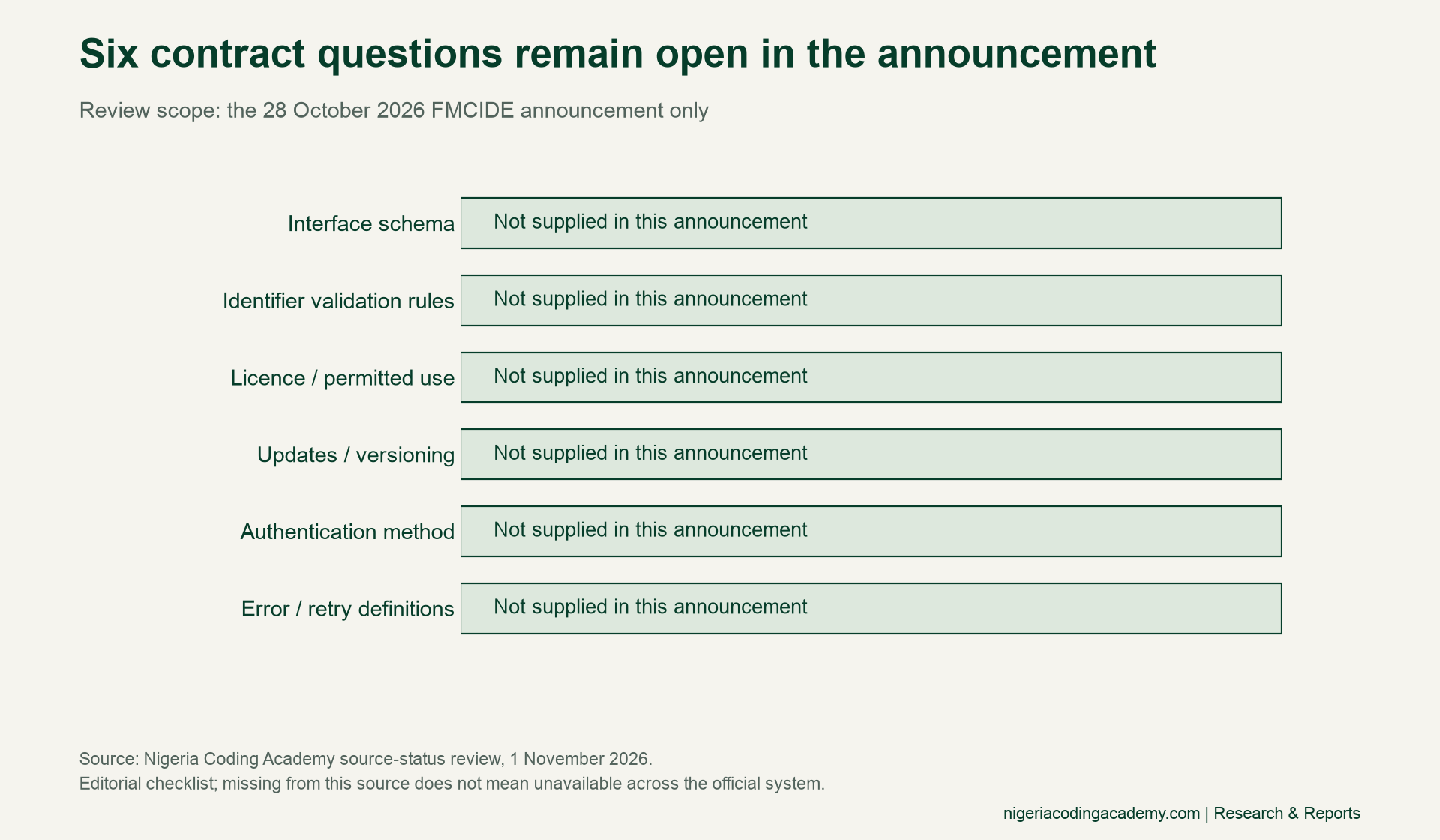
All six entries have the status unavailable in the reviewed announcement. That narrow finding is not a claim that the wider system lacks these features. In your own register, use verified when you retain adequate evidence. Use not applicable only with a reason. Leave an unknown visible until you resolve it.
NIPOST’s alphanumeric postcode explainer describes approved integration tools and an interest-registration route while developer services are being finalised. That article also retains a scheduled launch date that predates its displayed publication date. Treat it as background guidance and confirm current access terms directly; do not infer today’s API availability from that wording.
Likewise, an example code in a guide is not a complete validation specification. Store an authorised identifier as text according to the actual contract. Avoid writing a postcode generator or a validation rule by guessing from one example.

Model uncertainty before drawing a success screen
Your Nigeria postcode app needs a clear response when a lookup cannot settle the location. NIPOST’s building-selection guidance asks users to confirm the correct building and follow approved processes for missing or incorrect information. A nearby candidate should therefore not become an unquestioned final choice.
We designed six fictional cases for a teaching adapter. One supplies a single match. The other five cover no result, multiple candidates, a missing component, a conflicting correction and a simulated service failure. These are editorial choices, not an official conformance suite.
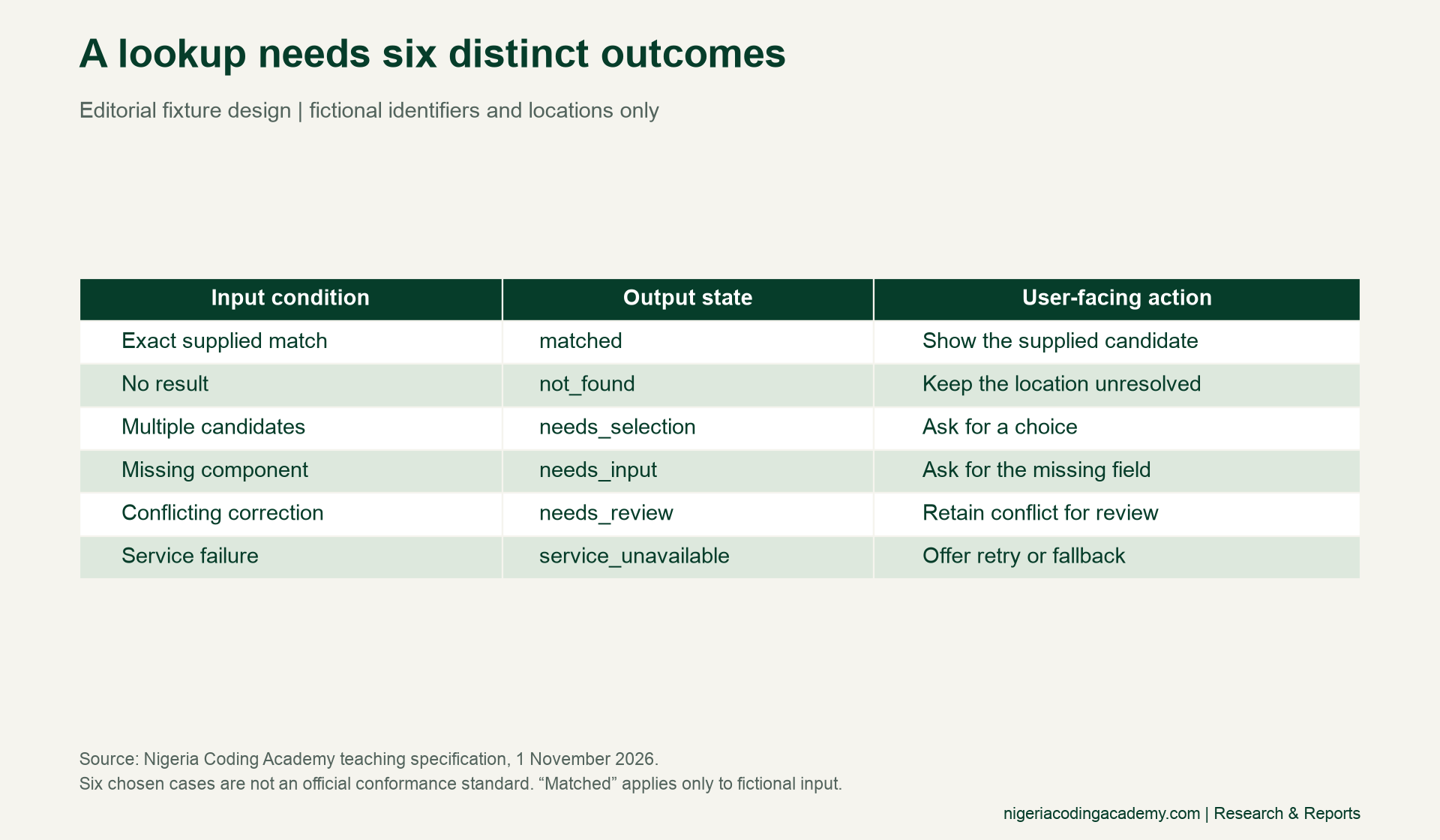
Keep the states distinct in the interface. For example, not_found means the exercise returned no candidate; service_unavailable means it could not complete the lookup. Showing both as “invalid address” would erase useful information. Similarly, retain a conflicting correction for review rather than silently overwriting the supplied record.
For a learner, this is also a practical exercise in branching and validation. Our guide to conditionals in decision making explains the underlying control-flow idea. Use those branches to preserve uncertainty, then test the wording shown to the user.
Reproduce the six-case offline exercise
The following self-contained Python example uses fictional labels such as DEMO_ONLY_A. They are opaque teaching identifiers and are not examples of valid official postcodes. No network library, credential or real address is involved.
def resolve(component, candidates, correction=None, service="ok"):
    if not component.strip():
        return "needs_input"
    if service != "ok":
        return "service_unavailable"
    if not candidates:
        return "not_found"
    if len(candidates) > 1:
        return "needs_selection"
    if correction and correction != candidates[0]:
        return "needs_review"
    return "matched"

cases = [
    (("fictional A", ["DEMO_ONLY_A"]), {}, "matched"),
    (("fictional B", []), {}, "not_found"),
    (("fictional C", ["DEMO_ONLY_C1", "DEMO_ONLY_C2"]), {}, "needs_selection"),
    (("", []), {}, "needs_input"),
    (("fictional E", ["DEMO_ONLY_E"]), {"correction": "DEMO_ONLY_OTHER"}, "needs_review"),
    (("fictional F", []), {"service": "offline"}, "service_unavailable"),
]
for number, (args, options, expected) in enumerate(cases, 1):
    actual = resolve(*args, **options)
    print(number, expected, actual, actual == expected)
Save the code in a local file and run it with Python 3. Our recorded run used Python 3.9.6 on macOS with an arm64 processor on 1 November 2026. The adapter returned the expected label for each of the six fixtures. One case returned matched; the other five correctly returned other states.
Unlock Your Unique Tech Path
Get expert tech consulting tailored just for you. Receive personalized advice and solutions within 1-3 business days.
Get Started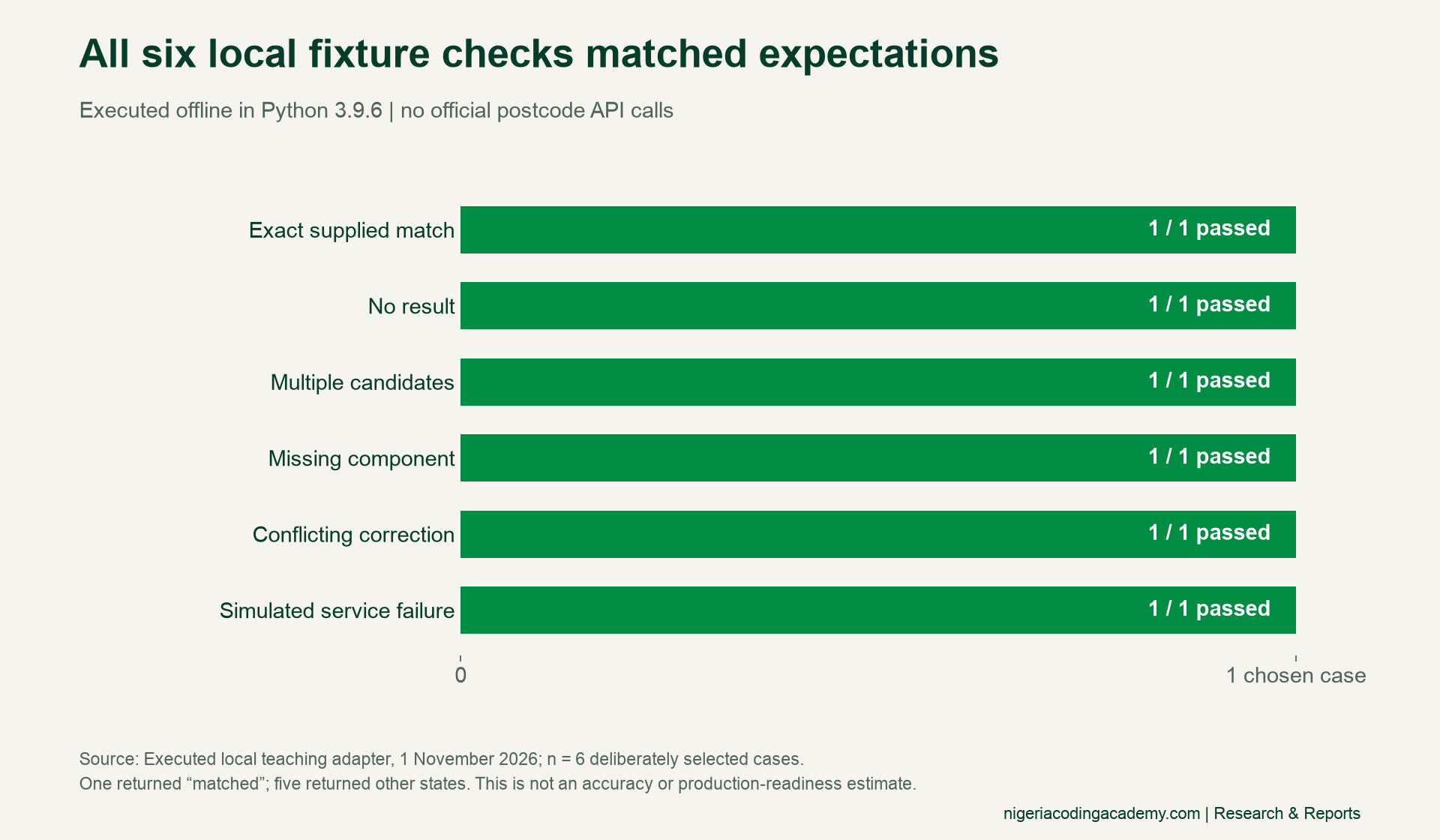
Six out of six checks means agreement with six deliberately selected expectations. It is not a population accuracy estimate. We wrote both the simple teaching implementation and its specification, so this result cannot independently validate an external service. It demonstrates an inspectable exercise that readers can modify and challenge.
Next, add cases that combine conditions. What happens when an incomplete input arrives while the service is unavailable? Our function prioritises the missing input. Record that decision before testing it. Otherwise, a changed order of checks may look like a bug when the expected behaviour was never agreed.
Downloads and field definitions
The reviewed register and executed results are populated research assets. The two blank tools let you document your own evidence and runs. Blank actual-result fields mean not yet recorded, rather than a pass or a failure.
- Source-status register (CSV): six requirements, evidence needed, review status, source and retrieval date.
- Executed synthetic results (CSV): case, condition, expected state, actual state, pass flag and evidence scope.
- Blank project evidence register (CSV): source, date, status, version or permission, owner and next action.
- Blank six-case test ledger (CSV): expected state, actual state, configuration, timestamp and evidence reference.
Use UTF-8 when opening the CSV files. Preserve the case identifiers so another reviewer can trace a result back to its fixture. Publish only fictional inputs and non-sensitive evidence. Keep credentials, home addresses and private integration documents out of a public portfolio.
When can a Nigeria postcode app replace the mock?
Replace the mock after you obtain and document authorised access, the actual interface contract and an appropriate test environment. Then adapt the six cases to that contract. An approved connection may use different states or require additional cases; preserve the original teaching assumptions so readers can see what changed.
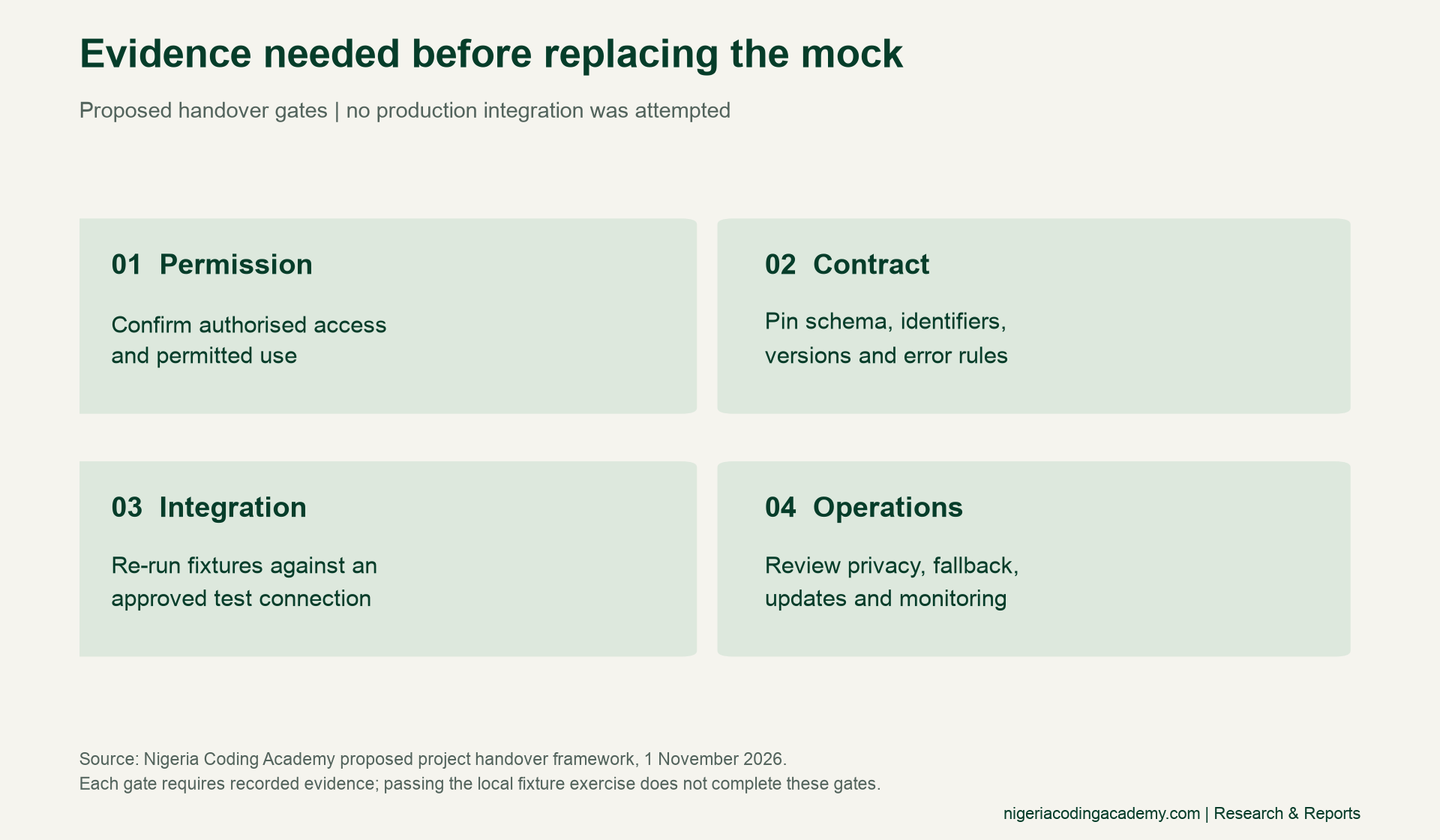
For each integration run, record the service version, configuration, time and observable response. Also record whether the interface handled that response correctly. A returned identifier and a usable user journey are separate observations. Neither alone proves successful delivery to a physical building.
Finally, review permission, privacy, fallback behaviour and updates before any deployment. Keep a clear change history using our version-control guidance. Pitch participation does not authorise reuse of another builder’s data or design, and this article grants no government certification.
Methodology, limits and citation
We separated three evidence types: the official event announcement, supporting NIPOST guidance and our own fictional teaching exercise. The source-status review asks whether the announcement supplies six specific contract items. It is not an exhaustive audit of every official portal or private developer document.
The local exercise classifies fixed inputs with deterministic rules. Its six cases were selected for instruction, without random sampling or a claim of national representativeness. We did not test any participating company, contact an official API, collect real addresses or measure delivery outcomes. The featured and inside illustrations are AI-generated conceptual artwork; the five figures use documented sources and the retained exercise data.
Suggested citation: Nigeria Coding Academy, “Nigeria Postcode App Projects: Verify the Data Contract Before You Build,” 1 November 2026. Cite the specific figure or CSV, preserve its scope note and link to this article. Readers may reuse our original fictional teaching fixtures and worksheets with attribution under CC BY 4.0; official material remains subject to its publisher’s terms.


