






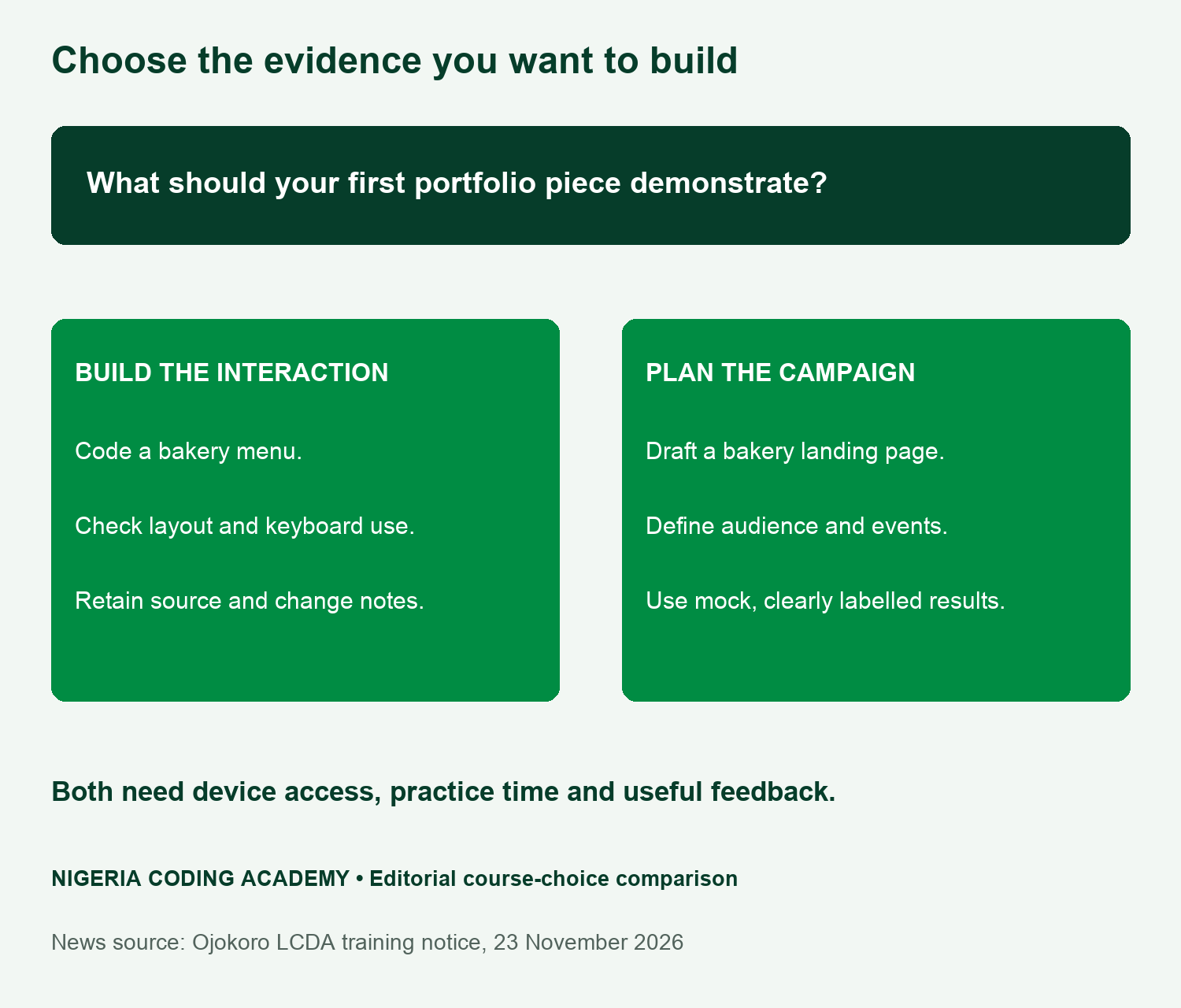
Choosing a front-end or digital marketing course in Nigeria starts with the work you want to show. Do you want to code a useful interaction, or plan how a page reaches and measures an audience? A course title alone does not establish which portfolio evidence you will leave with.
This guide compares two proposed projects for the same fictional bakery. It also gives you a device, schedule and travel checklist. In one clearly fictional budget, three four-hour sessions plus three 90-minute return journeys take 16.5 hours before practice. That is our planning example, not a confirmed training timetable.
Front-end or digital marketing course: use the current notice carefully
Ojokoro LCDA’s 23 November training notice advertises free resident courses, including front-end development and digital marketing. It lists HTML, CSS and JavaScript for front-end, and WordPress, email and advertising tools for marketing. The planned start is December 2026, with a weekday 10 a.m.–2 p.m. window and registration through the council headquarters’ ICT unit.
We did not verify an exact registration cutoff, total course length, current seat count or individual admission. Confirm those details with the provider before arranging travel. This article is an independent course-choice worksheet, not an application portal, admission guarantee or claim that Nigeria Coding Academy runs the council’s programme.
Start with one fictional client and two different outputs
Our bakery needs a simple mobile menu and a way to explain a new product to potential customers. Those are related needs, yet they require different evidence. Holding the client constant makes it easier to compare the work rather than attributing every difference to a more exciting business idea.
| Question | Front-end project | Digital marketing project |
|---|---|---|
| Main artifact | Coded mobile menu | Mock landing page and measurement plan |
| Evidence | Source files and interaction checks | Audience rationale and defined events |
| Useful review | Does the menu work as intended? | Does the plan connect audience, message and measure? |
| Do not claim | Tested sales or job outcomes | Real campaign results from mock numbers |
For the front-end route, define a small behavior: the menu opens, closes and remains usable at a narrow width. Keep the HTML, styling and interaction code together. Record the intended behavior and the checks you actually perform. A screenshot can show appearance, but it cannot by itself prove that an interaction works.
For the marketing route, draft the page’s message and explain whom it is intended to reach. Then define what would count as a useful action and how you would record it. A mock report should say mock beside its numbers. Do not present invented visits or enquiries as a real campaign’s performance.
Ask how feedback will improve the artifact
A useful class should let you explain why you made a decision, receive specific feedback and revise the work. Ask what a reviewer will inspect. For coding, that may include the source and behavior. For a campaign plan, it may include the audience rationale, message and measurement definitions.
Keep your own revision notes: what changed, which evidence prompted the change and what still needs checking. This creates a clearer portfolio story than a certificate alone. However, the worksheet does not rank providers or measure the value of any certificate. It helps you ask concrete questions before choosing.
Budget for time as well as tuition
Free tuition does not make the time commitment zero. Our sample budget assumes three sessions of four hours each, plus three return journeys of 90 minutes each. Classroom time is 3 × 4 = 12 hours; travel is 3 × 1.5 = 4.5 hours. The subtotal is 16.5 hours.
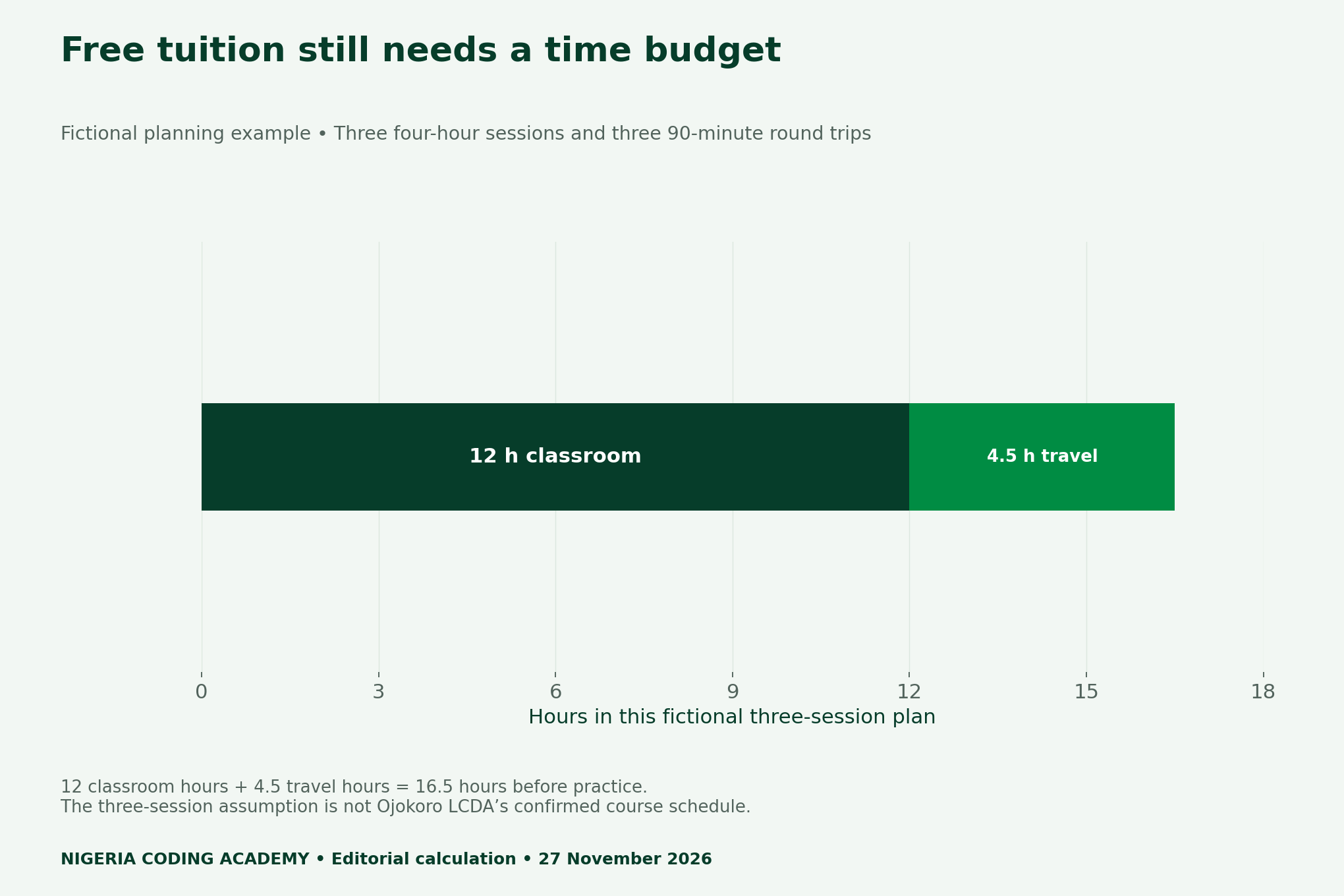
Add your own preparation and practice time separately. If a provider later confirms a different number of sessions, replace the assumption rather than multiplying an unverified course length. Likewise, record your own realistic journey estimate. A travel budget should reflect the route and times you expect to use.
Check devices, power and weekday availability
Before committing, ask which software and devices are provided and which you must bring. Then check whether you can access a suitable device for practice outside class. Do not assume that a phone-only workflow will meet every exercise merely because you can watch a lesson on it.
Next, compare the confirmed attendance window with work, caregiving and travel commitments. Keep your internet and power plan practical, including how you will retain files when a session ends. Ask the provider about accessibility or scheduling needs directly; the announcement alone does not answer every individual requirement.
Finally, choose a manageable first artifact. You can extend a coded menu later or add a real campaign after you have permission, a clear budget and valid measurement. The first decision should help you finish and explain one useful piece of work, rather than promising mastery of every tool listed in a course notice.
Download the course-choice worksheets
- Fictional three-session time budget (CSV)
- Proposed portfolio-output comparison (CSV)
- Blank device, schedule and travel checklist (CSV)
- Official notice and verification boundaries (CSV)
For further project context, explore our web development guides and Research & Reports. Use the worksheet with the actual requirements of the course you are considering.
Unlock Your Unique Tech Path
Get expert tech consulting tailored just for you. Receive personalized advice and solutions within 1-3 business days.
Get StartedMethod and limitations
Research checked on 27 November 2026. We read the council’s official notice, designed two fictional portfolio briefs and checked the sample time arithmetic locally. We did not attend or assess the course, verify current admissions, measure learner outcomes or run a real bakery campaign. The proposed projects and checklist are reusable planning tools, not evidence of a provider’s results.
Suggested citation: Nigeria Coding Academy, “Front-End Coding or Digital Marketing? Choose Your First Web Course”, 27 November 2026. Retain the fictional-budget and unverified-intake qualifications with any reused figure.


