






PHP 8.6 compatibility testing needs an explicit denominator. A homepage can load while an import callback or error handler changes. We executed fifteen selected teaching cases on a stable build and RC5, retaining all 30 observations across arrays, cURL callbacks and malformed JSON. They are a reproducible local fixture, not a whole-application safety certificate.
Our chosen stable baseline was PHP 8.5.12; the candidate was 8.6.0RC5. Both were built from checksum-verified official source archives as isolated minimal command-line environments. No installed PHP, production site or customer record was changed. The data keep returned values, exception classes and diagnostic messages in separate columns.
Release status: RC5 is a test build, not production PHP
The 5 November PHP announcement made RC5 available for testing and explicitly excluded production use. It planned general availability for 19 November: fourteen calendar days after that announcement. A planned date is not a completed release. We use the exact RC5 identifier because the notice’s ordinal wording is inconsistent.
There is a newer qualification. In a 9 November release-manager notice, the team scheduled an additional RC6 after an ABI incompatibility required an API-version bump and rebuilt extensions. Our retained observations remain RC5 observations. They cannot certify RC6, the eventual stable release or an extension compiled for a different API.
For a Nigerian course project or small web team, that distinction helps set scope. Use a separate local environment, preserve the current supported deployment policy and identify which project paths depend on the changed behaviour. Do not upgrade a live shop merely because a selected teaching matrix looks tidy.
PHP 8.6 compatibility testing: declare the thirty rows
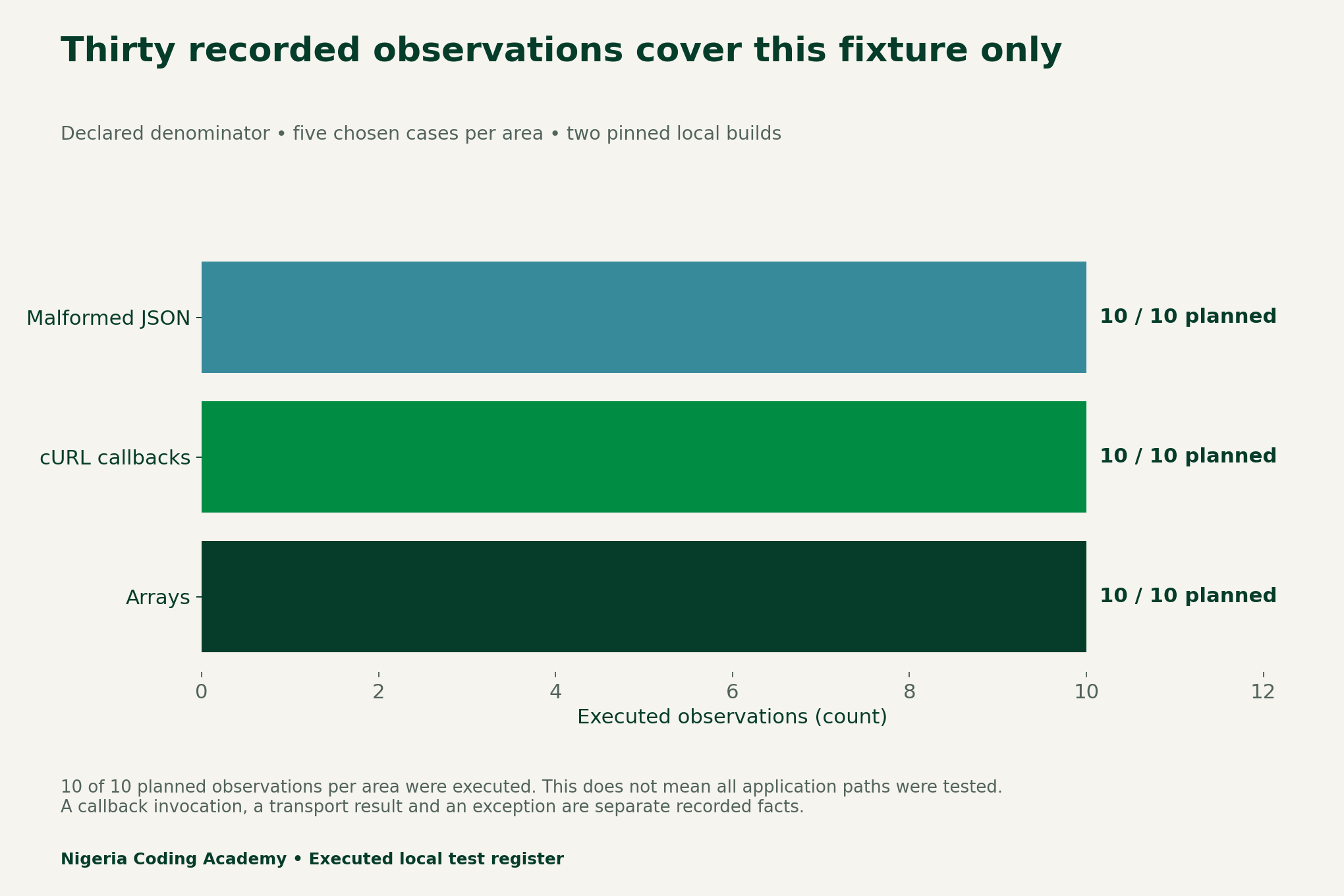
We selected five array cases, five callback cases and five malformed-JSON cases. Each ran once in a fresh process on each build. Fifteen cases multiplied by two runtimes gives 30 planned observations, and all 30 were executed. This covers the declared fixture only; it says nothing about the share of an application’s paths that it represents.
The runner records exact PHP version, enabled extensions, selected configuration and whether an INI file was loaded. Every process used the no-INI option. Both builds included cURL and JSON support. The stable build did not expose the abort and pause constant names; the fixture uses their documented libcurl numeric controls when names are absent and records that distinction. A missing extension would be a setup gap, not a successful compatibility observation. The blank register starts at not_run so planned work cannot silently become a pass.
Arrays: keep the visited sequence and final values
The RC5-tagged migration notes describe changed by-reference iteration after array compaction and pointer movement during copy-on-write. Our five selected examples retain both the visited sequence and the final array. They include plain iteration, deletion of the next element, appending, a sparse-array case and copying after deletion.
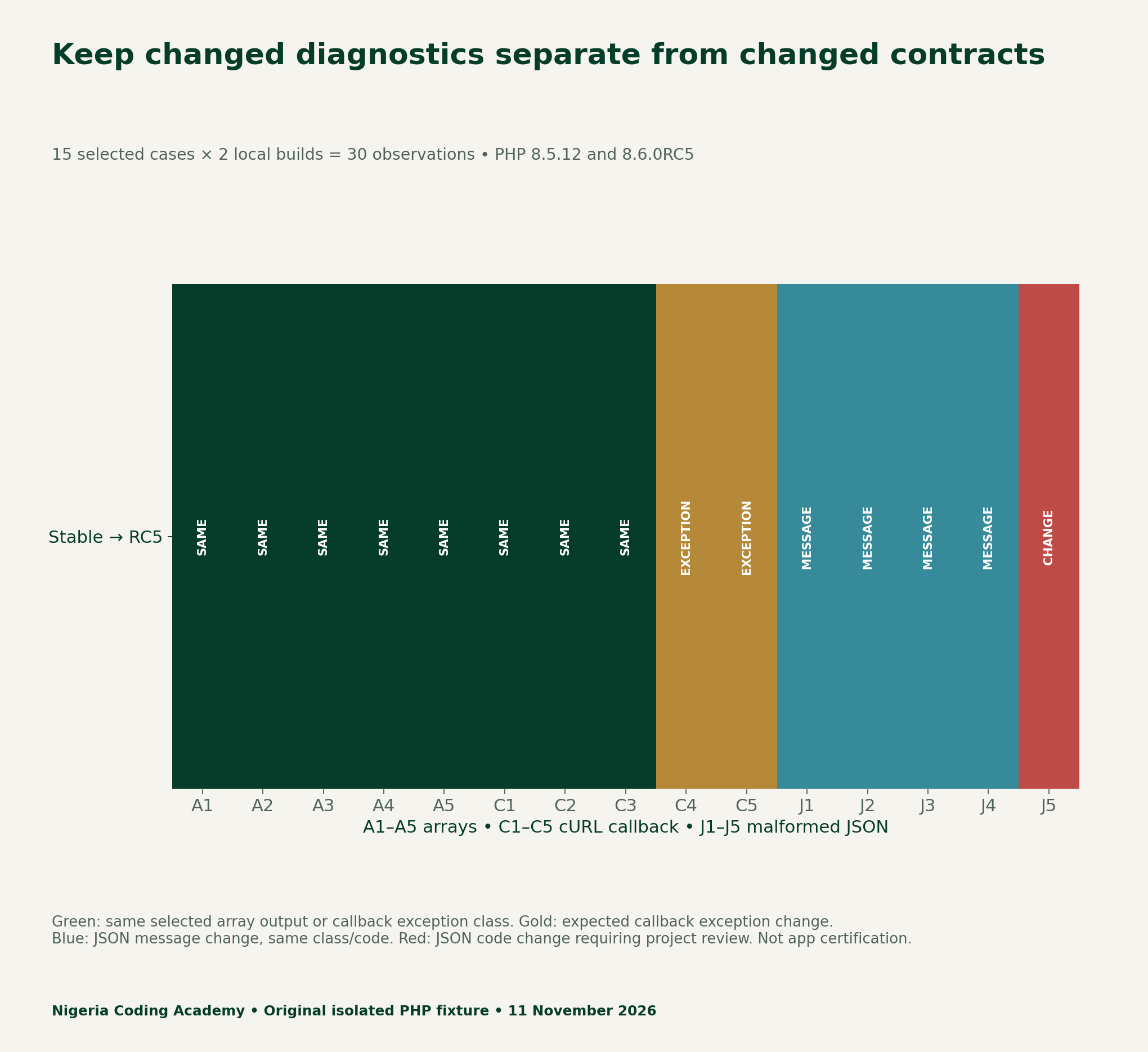
The selected array outputs in our run can be inspected row by row in the comparison file. Identical outputs on these inputs do not disprove the documented change. Conversely, a changed visitation sequence needs the original input and a stated expectation before it can be called an application defect. Five examples are not exhaustive coverage of compaction paths.
Keep the loop body free of unrelated business effects while diagnosing a difference. In a real import, visiting a row twice or skipping a row could change a database operation. Our fixture uses invented strings and integers and performs no such operation. A defensive iteration cap prevents an accidental endless teaching loop.
cURL: an allowed callback integer is not a successful transfer
The tagged notes specify three permitted integer outcomes for a read callback: zero, CURL_READFUNC_ABORT and CURL_READFUNC_PAUSE. Other integers raise ValueError in the candidate. Our cases exercise those three controls plus minus one and seven against a short-lived server bound only to the local loopback address. The libcurl callback reference explains their transport meanings.
The two deliberately invalid integers produce the expected exception-class change in our retained observations. The control cases keep transport results separate from exception results. Abort is an intentional control outcome; pause is not resumed in this fixture. A request can therefore abort, fail or time out without the integer being an invalid callback return.
Each row records whether the callback was invoked, the exception class and the cURL error number. Local transport details can vary between reruns. Do not turn “no ValueError” into “upload succeeded,” and do not describe a loopback test as validation of a payment gateway, hosting provider or remote integration.
JSON: keep diagnostic text separate from error identity
The migration notes also describe richer error-location information in JSON messages. We supplied five malformed strings: a single-quoted key, a missing object value, a trailing array comma, trailing text and an unterminated string. Each case uses JSON_THROW_ON_ERROR, and the data retain exception class, code and complete message independently.
All five selected inputs raise JsonException on both builds, while the retained messages change. Four retain error code four. J5 changes from code three (control character) to code four (syntax) in our run, so it needs a separate error-code review as well as a message review. No successful parse becomes a failure in this fixture. Keep user-facing wording and internal classification decisions distinct from a parser’s incidental phrasing.
Unlock Your Unique Tech Path
Get expert tech consulting tailored just for you. Receive personalized advice and solutions within 1-3 business days.
Get StartedThe PHP JSON decoding reference documents flags and error handling. A project should choose its error policy deliberately and retain valid-input controls as well. Our selected malformed-input exercise does not test every encoding, depth limit, application schema or business validation rule.
Read the evidence in layers
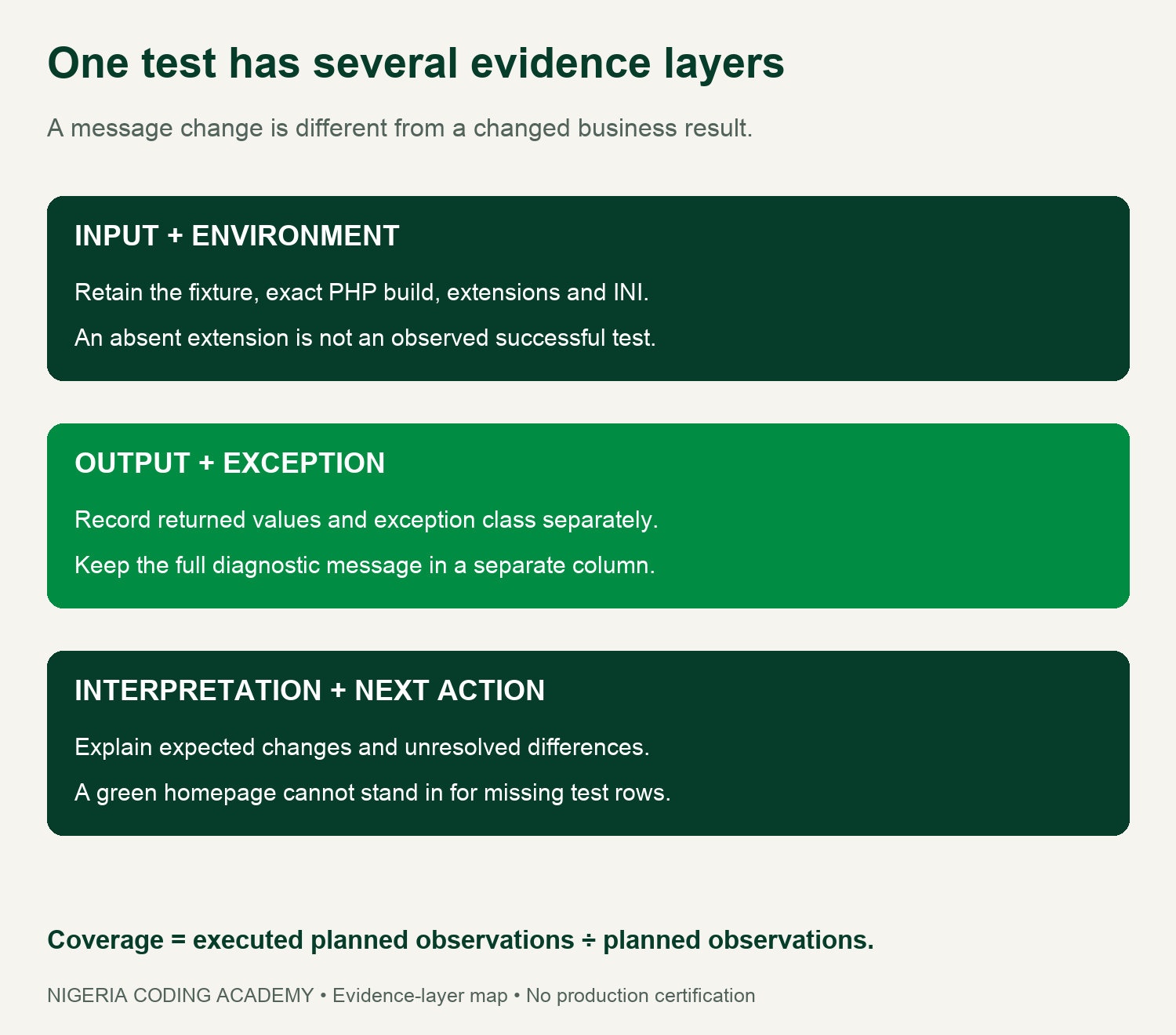
Start with the fixture and environment. Then inspect returned output and exception identity. Finally, explain the difference and decide the next project-specific check. This ordering prevents a revised diagnostic string from being confused with data corruption, and prevents an unchanged homepage from hiding an untested background job.
Our Node assertion study similarly separates contractual behaviour from snapshots. The synthetic masking fixture keeps residual fields visible alongside working joins. These examples share a narrow principle: show exactly what was checked before making a broader claim.
Download the fifteen-case audit kit
The original PHP compatibility fixture (ZIP) includes the PHP cases, Python runner, README and retained observations. It requires your own suitable PHP binaries with cURL and JSON. Its temporary HTTP server listens only on 127.0.0.1, makes no external request and shuts down after the run.
- Thirty raw PHP observations (CSV)
- Fifteen stable-to-RC5 comparisons (CSV)
- Declared and executed test denominator (CSV)
- Blank project compatibility register (CSV)
Keep expected changes, unexplained differences and not-tested states separate in your own register. Add the project’s actual imports, extension configuration and error-handling requirements. Repeat against later candidates and the eventual stable build. The planned release date and this local run cannot substitute for those checks.
Method, limitations and citation
Research and isolated execution checked 11 November 2026. We built official PHP 8.5.12 and 8.6.0RC5 sources with minimal CLI, cURL and core JSON on macOS arm64, then executed 30 selected observations. We tested no web application, external transport, production deployment, throughput or release-wide compatibility rate. Transport error details may vary; the fixture is intentionally small.
Suggested citation: Nigeria Coding Academy, “PHP 8.6 Compatibility Testing: A 15-Case Audit,” 11 November 2026. Cite PHP for release and migration documentation, and this report for the selected fixture and local observations. Send evidence-backed corrections through our contact page.


