







A PostgreSQL replication slot invalidation forecast divides a remaining WAL reserve by an observed generation rate. That can be useful warning arithmetic, but it is not a guaranteed countdown. Change the observation window, workload or consumer behaviour and the estimate can change even when the underlying formula is correct.
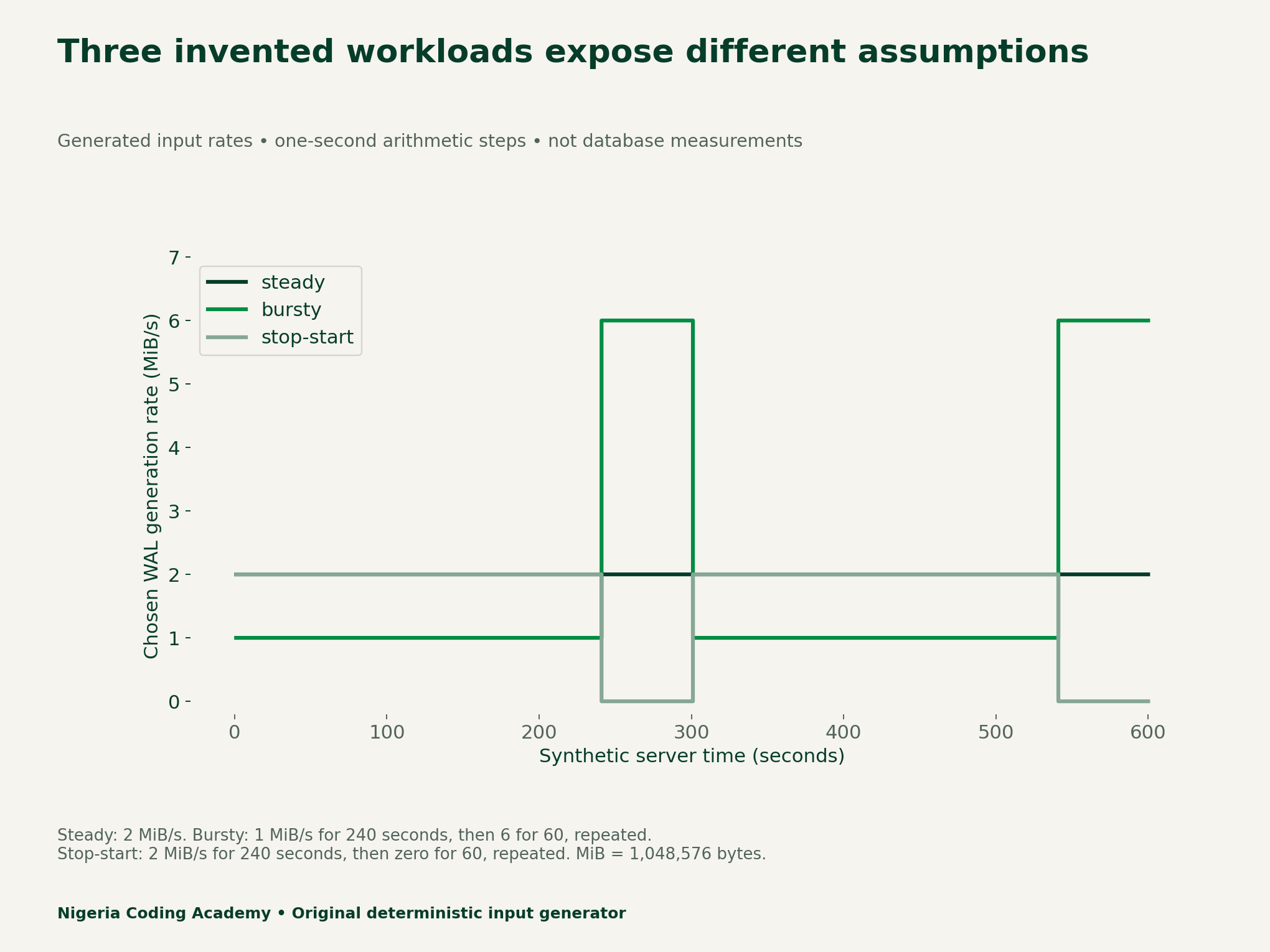
We executed an original synthetic fixture with 1,803 invented WAL-position samples, 99 window comparisons and eight formula-guard cases. It uses steady, bursty and stop-start patterns. No PostgreSQL cluster, Dasha instance or Nigerian production system was accessed. The figures teach the calculation; they do not measure outage prevention.
What changed in Dasha’s November release
The 9 November Dasha 1.10 announcement describes a slot-invalidation forecast using two server-timed LSN samples over a chosen 30-second to five-minute window. It combines the observed WAL rate with retained WAL and remaining configured reserve. This is a documented implementation description, not an independently verified forecast-accuracy result.
The same notice describes activity sampling every one to ten seconds and a maximum of one activity sample per second per host per Dasha instance. That is a different collection path from the WAL measurement window. Do not turn an activity-refresh interval into the denominator of a WAL-rate calculation or assume several monitoring instances share one global sampling ceiling.
For Nigerian backend learners, a controlled numerical fixture is a useful starting point. It makes the units and missing states inspectable without adding a dashboard to someone else’s database. Our work models a simple ratio, not Dasha’s internal implementation or a complete PostgreSQL failure process.
Derive the WAL rate from comparable samples
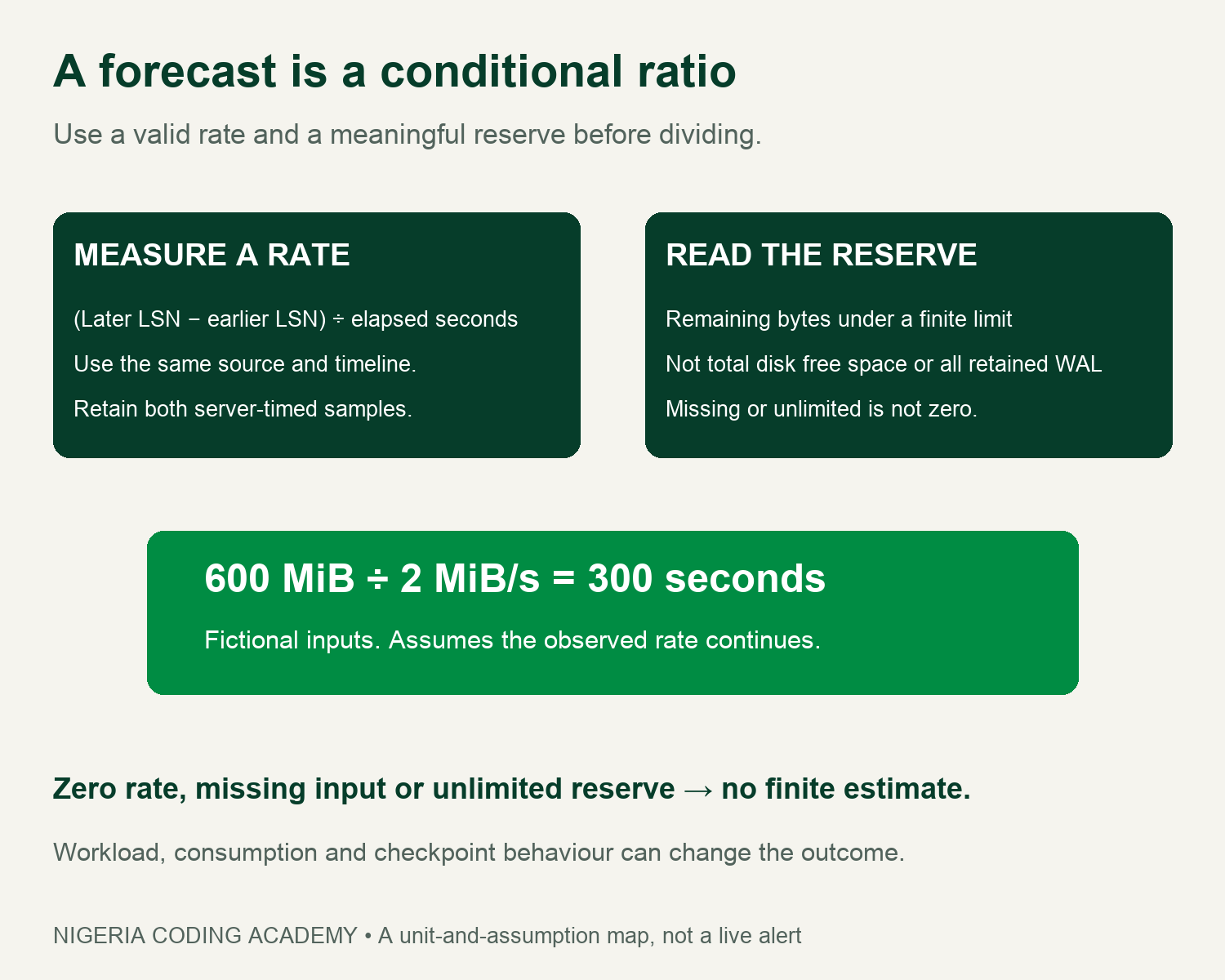
An LSN identifies a position in the WAL stream. For a valid same-source pair, subtract the earlier byte position from the later one, then divide by positive elapsed server time. Sixty MiB generated over 30 seconds gives two MiB per second. Here one MiB means 1,048,576 bytes, not one million bytes.
Keep both sample positions, timestamps, source identity and chosen window in the worksheet. Mixing a primary sample with a different source or timeline can make an apparently neat subtraction meaningless. Also reject missing positions, non-positive elapsed time and a backwards delta in this simplified check. Our eight guard cases exercise these explicit rules locally.
The generator expresses selected integer positions in PostgreSQL-style LSN notation for inspection. They are invented values, not retrieved database addresses. Its clock is a synthetic sequence of integer seconds. We did not test clock drift, connection latency, failover sampling or the behaviour of a real monitoring client.
Use the right reserve in the numerator
The PostgreSQL 18 slot-view reference describes safe_wal_size as the additional WAL bytes that can be written before a slot risks becoming lost. It is null for a lost slot and when max_slot_wal_keep_size is minus one. That null is not an observation of zero spare bytes.
The replication-setting reference defines the configured retention limit at checkpoint time and documents the unlimited minus-one setting. Therefore, remaining slot reserve, total retained WAL and filesystem free space are different quantities. Record the actual version and field meaning instead of substituting one convenient capacity figure for another.
Our fixture chooses a constant remaining reserve of 600 MiB. Dividing it by two MiB per second gives 300 seconds, or five minutes, if that rate continues and the reserve does not recover. We hold the reserve fixed at every plotted endpoint to isolate window sensitivity. It is not a time series of a draining live reserve.
PostgreSQL replication slot invalidation forecast: change the window
For each path, we calculate at eleven endpoints from second 300 through second 600, spaced 30 seconds apart. At each endpoint, we use windows of 30, 60 and 300 seconds. Three workloads multiplied by eleven endpoints and three windows gives 99 forecast rows. The numerator stays at the chosen 600 MiB in every row.
At second 300, the bursty path has generated six MiB per second during its most recent minute, but averages two across its last five minutes. The short windows therefore imply 100 seconds, while the long window implies 300. The difference follows from the chosen input path; it is not a measured error rate or evidence that one window is always better.
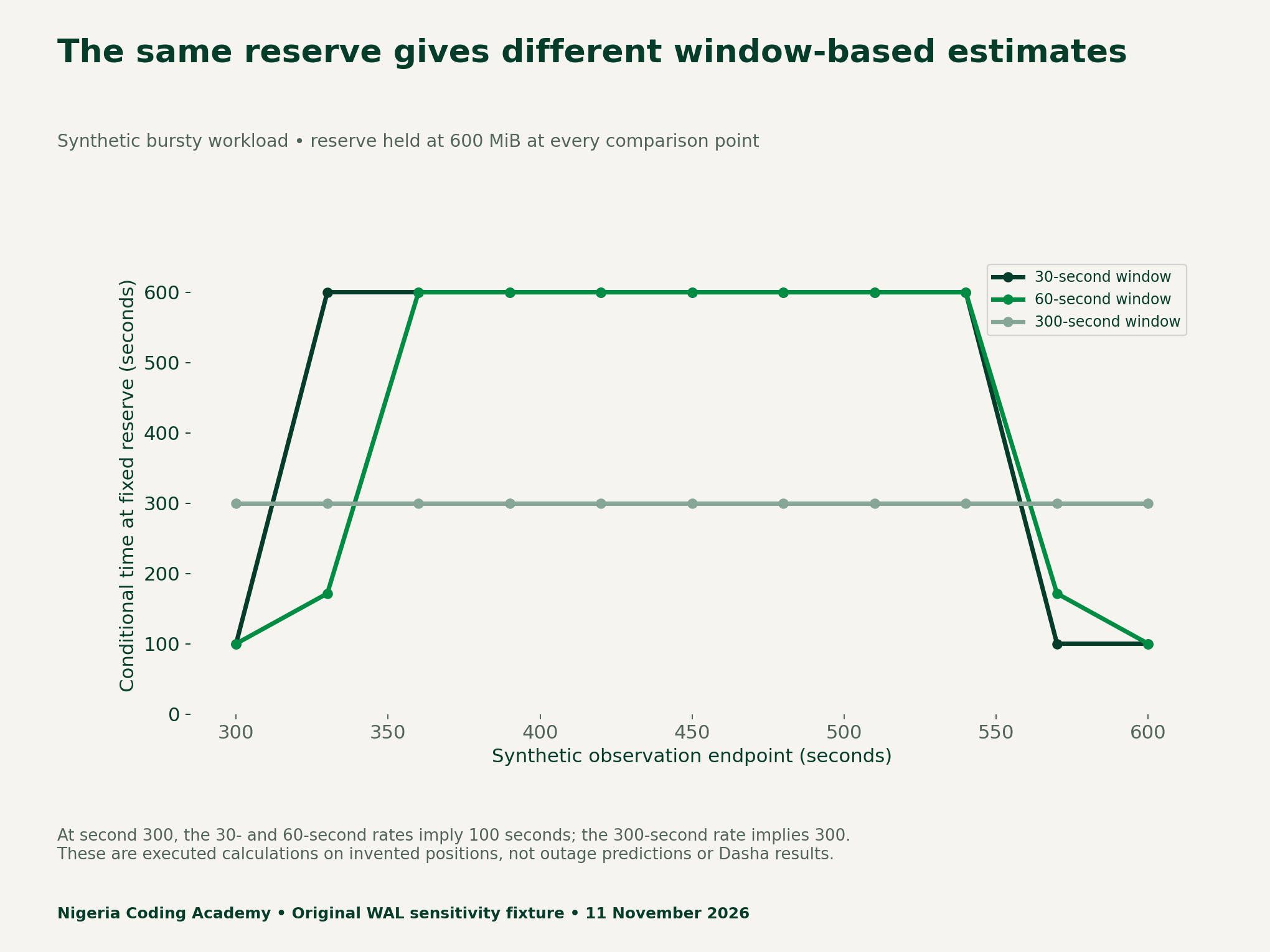
A shorter window reacts more quickly to this constructed burst. A longer window smooths the past and can retain a positive average after recent generation stops. Neither property alone establishes which estimate will be useful on an unfamiliar workload. That would require observed future outcomes, a defined evaluation rule and more than our selected teaching paths.
Keep zero-rate and missing states visible
At second 300 on the stop-start path, the 30- and 60-second windows contain no generation. Their estimated times remain blank with a zero_observed_rate status. The 300-second window still averages 1.6 MiB per second, implying 375 seconds under the same fixed-reserve assumption. Zero generation does not prove permanent safety.
Unlock Your Unique Tech Path
Get expert tech consulting tailored just for you. Receive personalized advice and solutions within 1-3 business days.
Get Started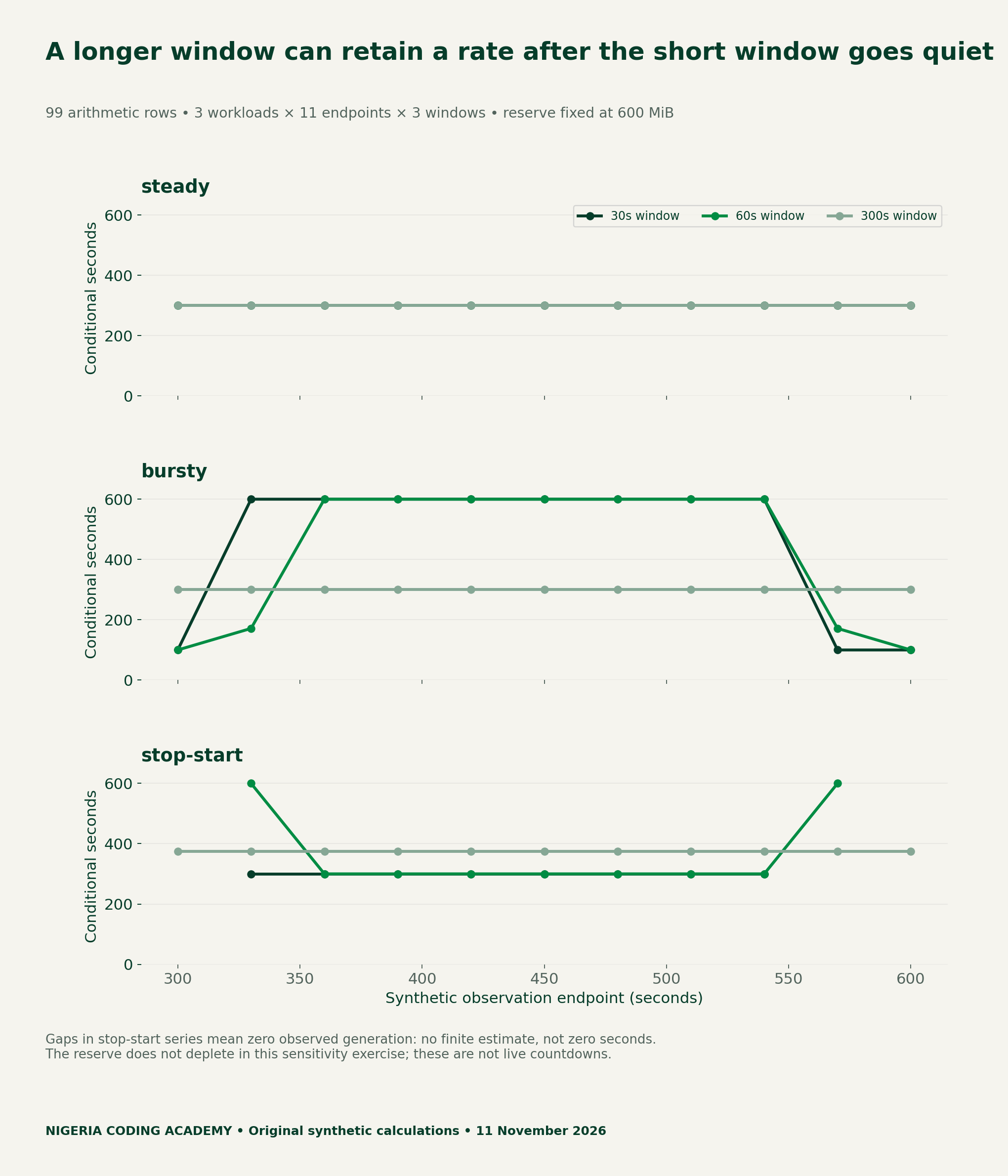
A missing sample is different from an observed zero delta. An unlimited configuration is different again. Retain those states separately so an empty field cannot silently become a zero in a chart or alert. Our guard file also distinguishes an invalid elapsed interval, a backwards position, a negative reserve and a changed source.
Use a forecast as a prompt to inspect evidence
Before interpreting a warning, inspect the slot state, consumer progress, sample age, workload change and relevant configuration. PostgreSQL’s slot view distinguishes reserved, extended, unreserved and lost states. A slot can also be invalidated for reasons beyond this simple capacity ratio. The current state and reason fields matter alongside any estimate.
Do not drop a slot or change a live retention setting merely because this worksheet produces a short time. Such actions can affect replication and recovery. Escalate through the owner’s operational process with retained evidence. This article provides an offline learning tool and issues no database-changing command.
Our pgBadger reconciliation study concerns execution counts rather than future reserve. The synthetic masking fixture likewise separates a narrow check from a broader claim. Here the narrow evidence is a declared ratio on invented inputs.
Download and reproduce the calculations
The synthetic WAL forecast fixture (ZIP) includes the original generator, README and retained data. Run python3 wal_forecast_fixture.py output with Python 3.9 or newer. It uses the standard library, makes no network calls and requires no database connection. The same chosen paths reproduce the same calculations.
- Original synthetic WAL-position samples (CSV)
- Ninety-nine window and reserve calculations (CSV)
- Eight executed formula-guard cases (CSV)
- Blank rate and reserve worksheet (CSV)
The formula file records both sample positions, elapsed window, byte rate, reserve and status. Empty forecast cells have a reason. The blank worksheet is for your own authorised observations, not permission to collect private database diagnostics. Keep production details and credentials out of public examples.
Method, limitations and citation
Research and original arithmetic checked 11 November 2026. We inspected the Dasha release notice and PostgreSQL 18 references, then executed deterministic rate, reserve and guard calculations. We did not model consumer catch-up, checkpoint timing, reserve depletion, recovery actions or actual slot-loss events. No forecast-accuracy or outage-prevention claim follows.
Suggested citation: Nigeria Coding Academy, “PostgreSQL Replication Slot Invalidation Forecast,” 11 November 2026. Cite Dasha for its documented feature and PostgreSQL for field semantics; cite this report for the synthetic fixture and calculations. Send evidence-backed corrections through our contact page.


