




GitHub issue types help a personal project describe its work. Yet a category is useful only when its meaning is clear. A ticket called “improve search” may hide a bug, a new feature or an unclear request. Counting tickets will not resolve that ambiguity.
We built a 12-card exercise for a fictional campus book exchange. Two written rule versions produce nine unchanged classifications and three moves to clarification. A Python script reproduces the comparison. This is a rule-consistency teaching exercise, not an independent reviewer study or a productivity measurement.
What changed for GitHub issue types
GitHub’s 11 November 2026 announcement makes issue types and fields generally available for personal-account repositories. Default types are Bug, Task and Feature. Default fields are Priority, Effort, Start date and Target date. Accounts can configure up to 25 types and 25 fields; supported field formats include text, number, date, single-select and multi-select.
Those are configuration options, not targets to fill. A small learning project can start with a clear type definition and only the fields it will actually use. Our study changed no account settings, created no issues and invited no collaborators.
Separate type, priority and effort
Type describes the kind of work. Priority describes why the work matters now. Effort describes the expected work involved. A small defect can be urgent, while a large new feature can wait. One label should not silently represent all three dimensions.
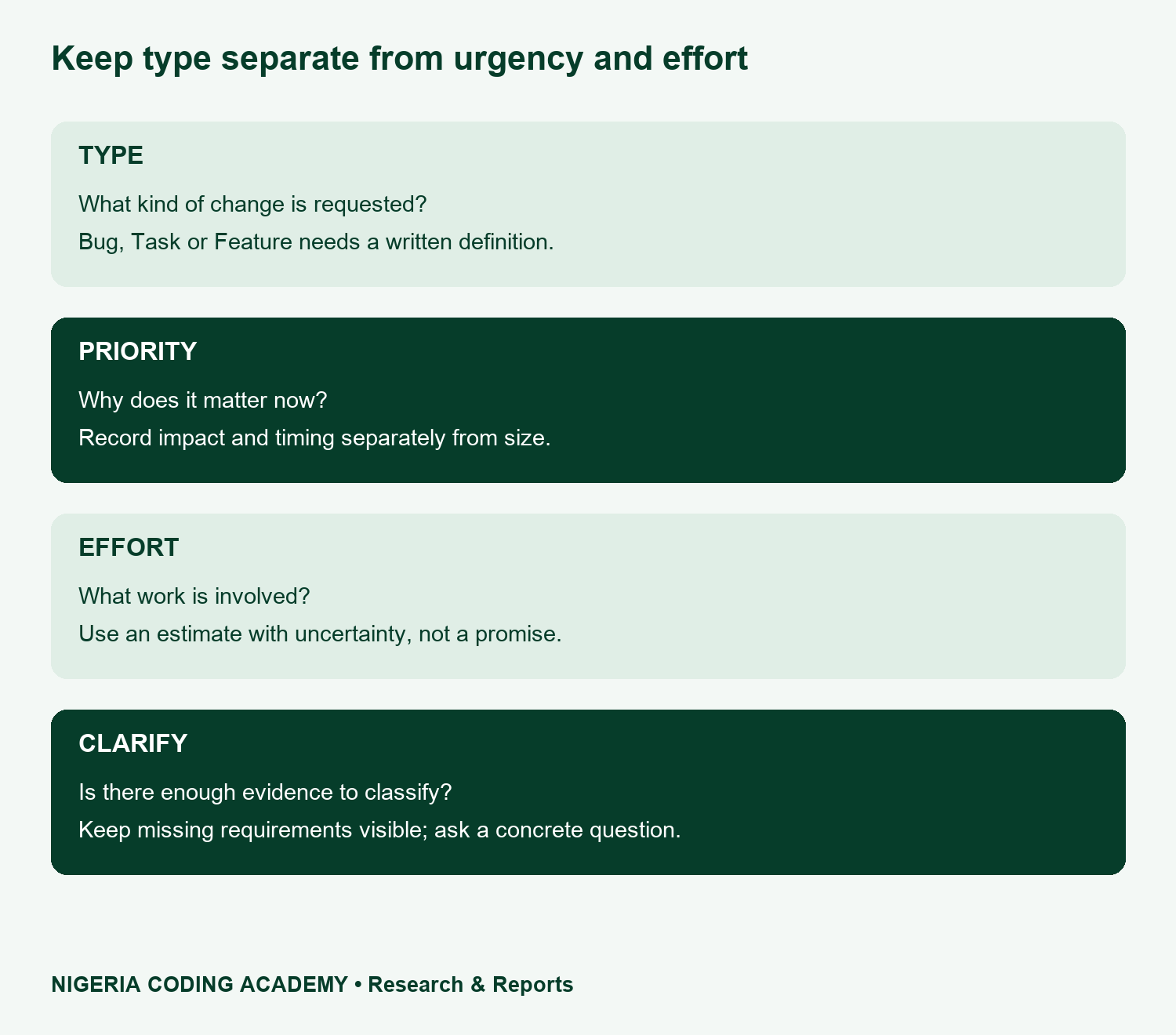
For this exercise, a Bug contradicts a stated existing requirement. A Feature asks for an explicitly absent capability. A Task has a concrete maintenance scope without an intended product-behaviour change. If the card lacks enough information, version 2 leaves it unclassified and records a clarification request.
The fictional twelve-card pilot
The download contains nine straightforward cards and three deliberately vague ones. Every card belongs to an invented campus book exchange. No real student, transaction, client or school record appears in the exercise. Card IDs make the inputs and decisions easy to compare.
Straightforward defects include an exact-title search that omits its required match and a reservation rule that allows a prohibited duplicate. New capabilities include saved searches and a collection-point filter that do not yet exist. Maintenance tasks include updating setup instructions and reorganising test fixtures while preserving behaviour.
The final cards say “search feels wrong,” “add a better reservation” and “improve catalogue.” Their missing requirements are intentional. A reviewer should ask what behaviour is expected, what currently happens and which change is actually requested. A confident category cannot substitute for those answers.
What the two rule versions do
Version 1 accepts the card’s stated intent. It maps defect, new capability and maintenance to Bug, Feature and Task. It contains no evidence gate. As a result, each type receives four cards, including one vague request.
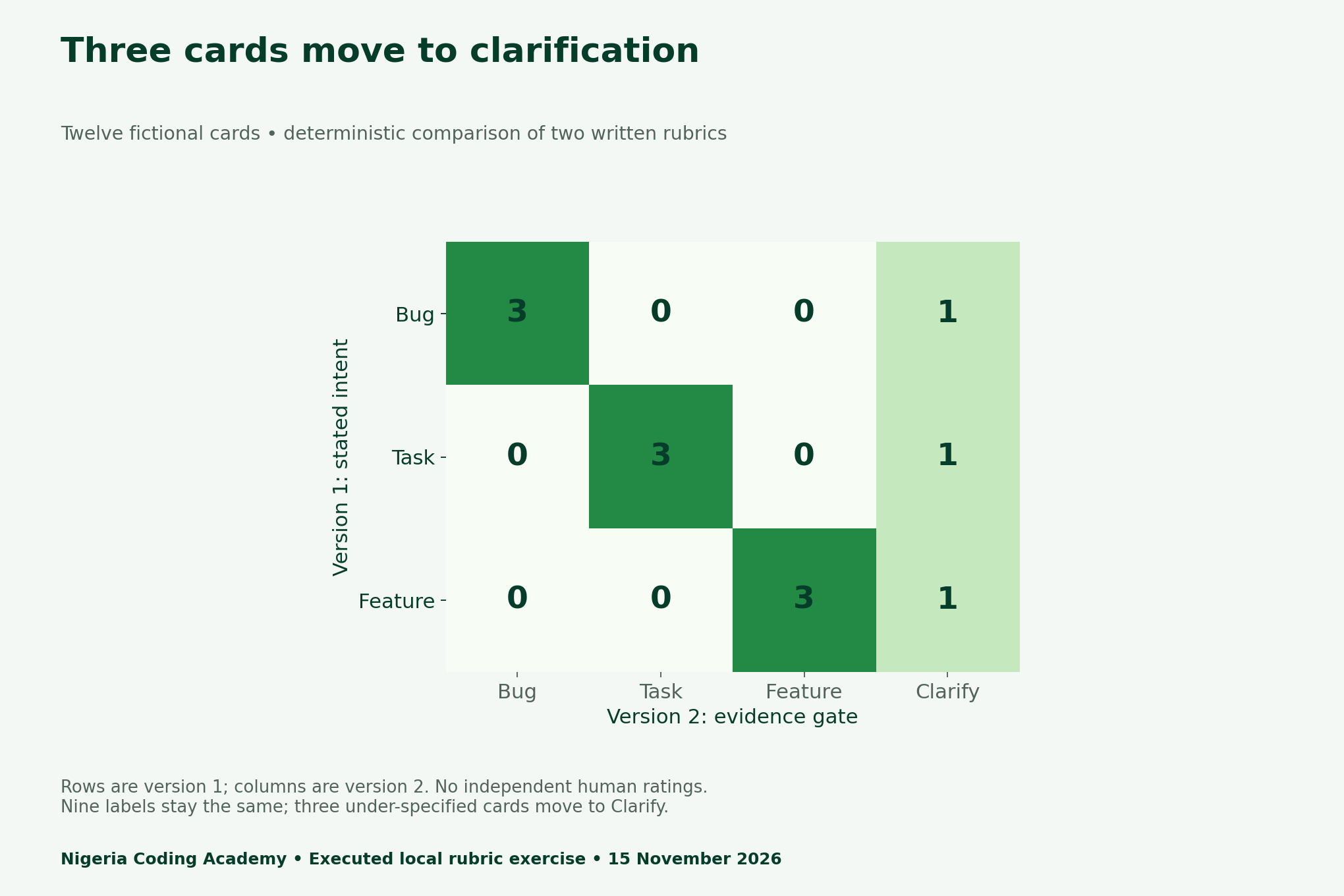
Version 2 adds an explicit sufficiency gate. The nine clear cards keep their labels. The three vague cards move to Clarify because a requirement or concrete scope is missing. The script reads the structured evidence flag; it does not use a language model or infer meaning from arbitrary issue prose.
How to interpret the counts honestly
Nine of 12 labels remain unchanged, and three of 12 move to clarification. That arithmetic describes this designed set only. We deliberately selected its composition. It cannot estimate how often a real team disagrees or how much time a taxonomy saves.
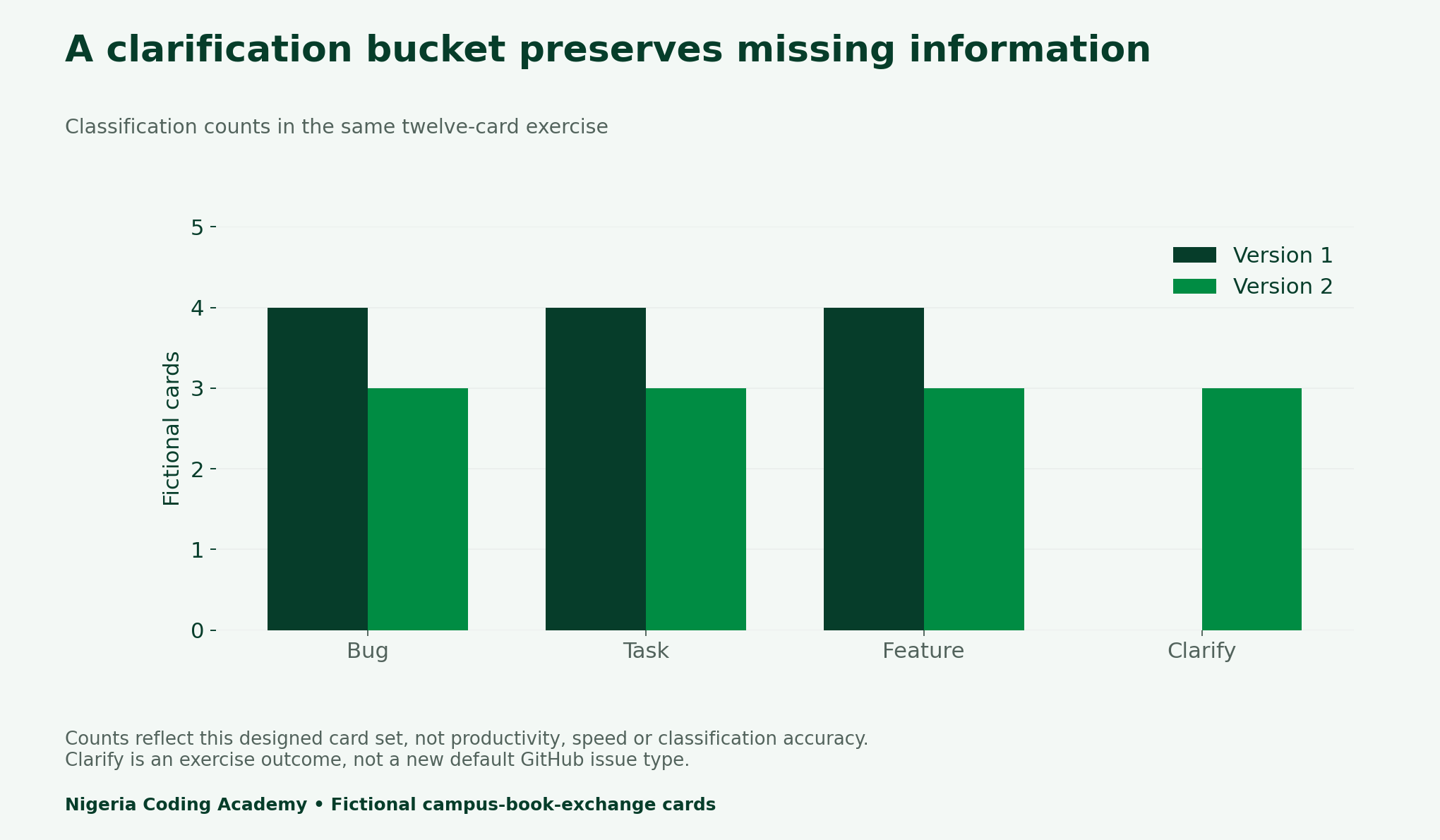
We had no independent human classifications for this publication. Therefore, there is no inter-rater reliability result, reviewer agreement rate or measured before-and-after team improvement. The reproducible output is a comparison of two explicit rules on the same fictional inputs.
Run a real discussion without hiding uncertainty
For a coding-club session, give each participant the same card set and definition sheet before discussion. Ask them to record a type or clarification outcome and a reason. Keep their first classifications unchanged in the ledger; add later decisions in separate columns.
If you have two independent reviewers, declare the agreement denominator before calculating it. Retain unresolved and unclassified cards rather than deleting inconvenient cases. Reusing the same cards after discussion introduces learning effects, so a later match rate is not clean causal evidence of better definitions.
Unlock Your Unique Tech Path
Get expert tech consulting tailored just for you. Receive personalized advice and solutions within 1-3 business days.
Get StartedYou can also run this alone. Label it a self-consistency exercise and retain the rule version and date. The useful outcome may be a clearer requirement, not a higher score. A learner should be able to explain why a card needs clarification and what evidence would resolve it.
Use only the fields that support a decision
Begin with a short priority definition and a modest effort scale. Keep start and target dates only when they support actual planning. Do not fill all available fields merely because the interface permits them. Missing estimates should stay unknown until there is enough information.
The official GitHub Issues guide provides context for recording and managing work. Before publishing a portfolio issue, remove private client details and unnecessary personal information. This fictional pack needs no live repository to run.
Download the cards, rules and reproducible comparison
- Twelve fictional campus-book-exchange issue cards (CSV)
- Two versioned type-definition sheets (CSV)
- Observed rule-version comparison ledger (CSV)
- Blank issue triage and clarification ledger (CSV)
- Python classifier, fictional cards and instructions (ZIP)
Our survey metadata-contract exercise applies a similar rule: keep a label attached to its meaning. The CI coverage study explains another case where a reassuring status needs supporting evidence.
Methodology and limits
We executed the standard-library classifier locally on 15 November 2026. It retains all 12 input cards, both rule versions and the resulting ledger. The program asserts that exactly three labels change. Its environment record is kept with the study files.
The exercise is small, deliberately composed and deterministic. It does not test GitHub’s interface, measure developer productivity or establish hiring value. Its reusable contribution is a transparent card set and a way to document uncertainty without manufacturing independent human evidence.


