







Cloudflare Workers image transformations can be useful when you are prototyping a shop catalogue, but a broken image URL does not automatically mean you need to buy a domain. First separate the source hostname, the active configuration and the response you actually received. That is a more useful debugging trail for Nigerian students and freelancers.
This guide provides four proposed checks using owned sample images, a response register and a configuration-boundary infographic. It also shows a clearly fictional byte calculation: 240 KB reduced to 80 KB would be 66.7% smaller. We did not make a Cloudflare transformation request, deploy a Worker or measure a service benchmark for this report.
Cloudflare Workers image transformations: the current change
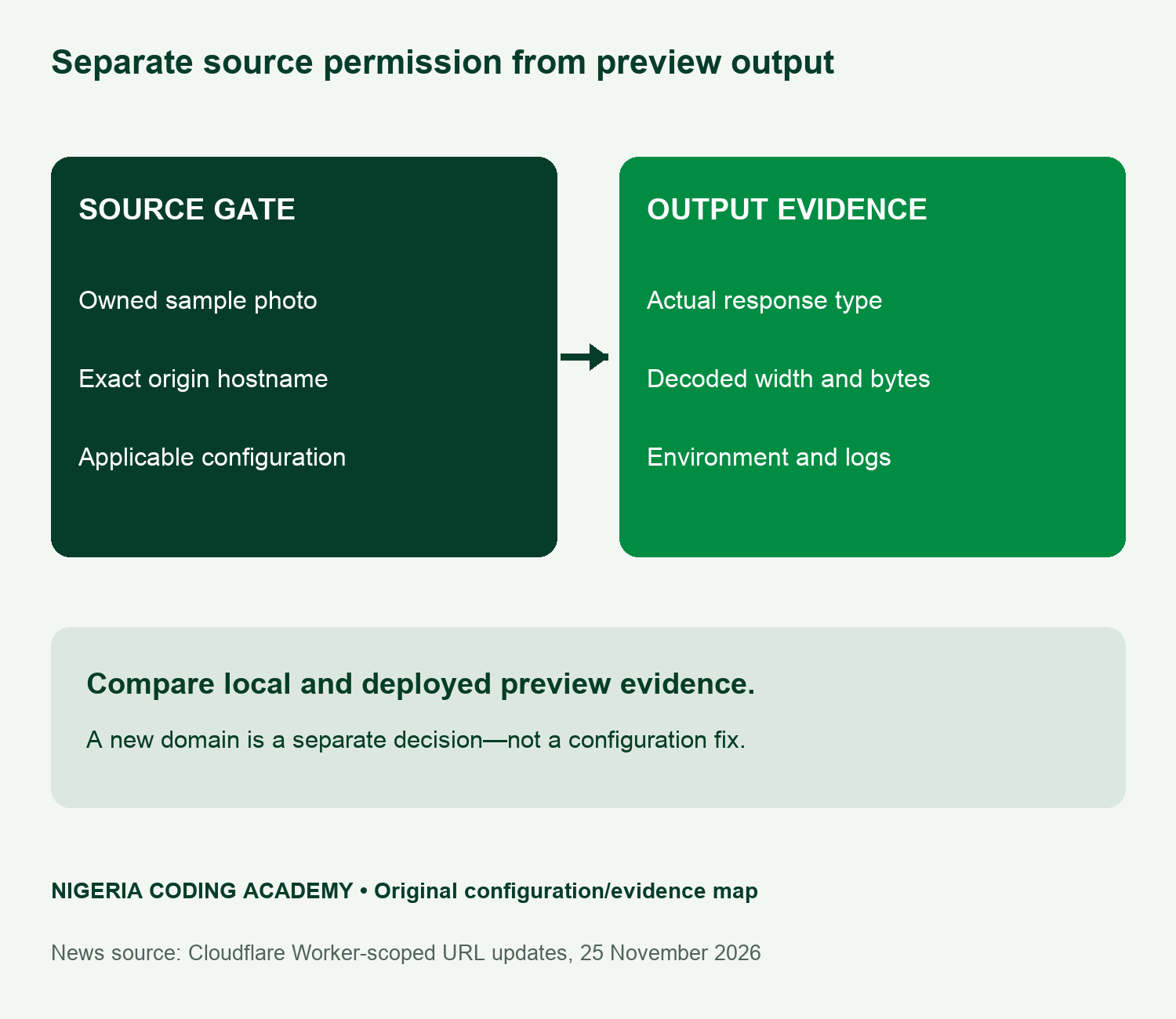
Cloudflare’s 25 November changelog adds Worker-scoped transformation URLs on workers.dev and in local development. On connected custom domains, the Worker settings override zone settings. External image sources can be configured with up to ten hostnames. That allows a relevant preview path without first attaching a custom domain; it does not establish that your current configuration is correct.
The same source distinguishes allowed_origins in Wrangler from allowedOrigins in the Cloudflare CLI configuration. Named environments need their own configuration. It also says removing the setting alone leaves deployed behavior active: disable it explicitly and deploy that change when needed. Verify the tool and environment you actually use rather than mixing examples.
Start with harmless images you control
Choose a small product-photo fixture that you own or have permission to use. Keep it free of private customers, access tokens and personal information. Record the image’s original location and a stable label. This makes it possible to compare the intended input with the output later without relying on memory.
Use a second owned sample hostname for the case outside the configuration. The purpose is to observe a configuration boundary, not to work around one. Record the actual response and stop at that boundary. Do not substitute arbitrary third-party images or treat a rejected source as permission to bypass a restriction.
Four checks before a domain decision
| Proposed case | Setup | Evidence to retain |
|---|---|---|
| Allowed external origin | Owned image hostname listed | Inspect intended image and response |
| Origin outside configuration | Second owned hostname not listed | Record actual response; do not bypass restriction |
| Local preview | Same intended local settings | Inspect type, width, bytes and logs |
| Deployed workers.dev preview | Authorized test deployment only | Repeat inspection with deployed configuration |
First, inspect the allowed-origin case. Confirm the intended hostname rather than assuming a similar-looking URL is equivalent. Retain the configuration revision, the requested input and the resulting response. A page showing an image may still be using a different source or a cached resource from an earlier test.
Second, exercise the deliberately unconfigured origin only with an image you control. Write down what happened. Leave the expected boundary separate from the observed response: an intended rejection is not evidence that a rejection occurred. This is why the response worksheet starts blank.
Third, check the local preview. Then repeat the relevant inspection on an authorized deployed workers.dev preview. Keep their evidence separate. A successful local display does not prove that the deployed named environment has the same settings, and a deployed response does not document what your local setup did.
Measure type, width and bytes—not appearance alone
For each actual run, record the returned content type, decoded pixel width and response bytes. Note the environment and relevant cache context too. A screenshot can show composition and cropping, but it cannot reliably tell you the file type, response size or which configuration produced the image.
Keep the unit consistent. Decimal KB means 1,000 bytes; KiB means 1,024 bytes. If two tools use different units, compare the raw bytes first. Likewise, distinguish encoded response bytes from a file that you decoded or resaved afterward. Those are different measurements and should not silently share a column.
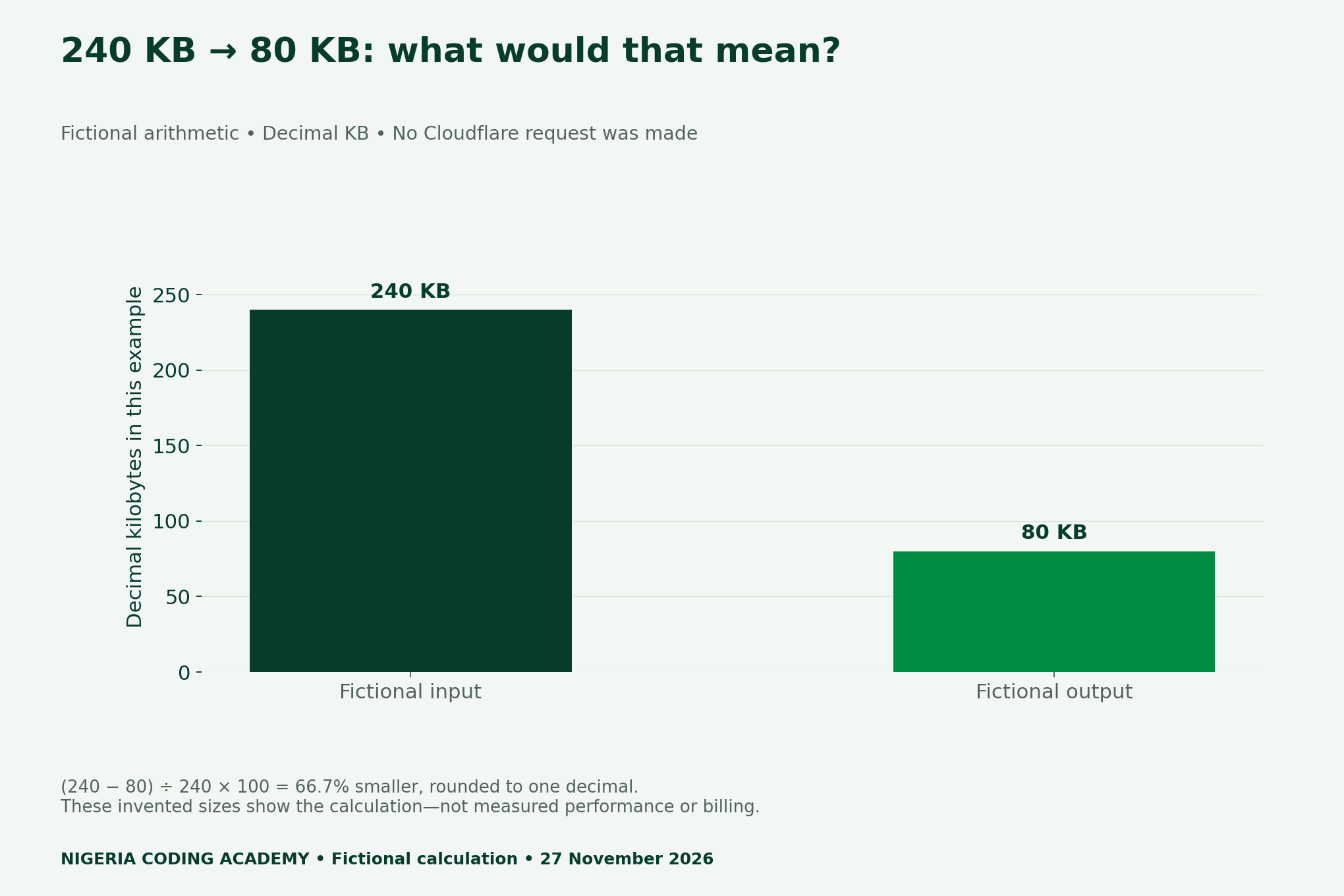
The example subtracts 80 from 240 to get 160 KB saved. Dividing 160 by the original 240 gives two-thirds, or 66.7% when rounded to one decimal. Use the original size as the denominator. Dividing by the output size would answer a different question and would not be the percentage reduction.
A domain purchase cannot replace an evidence trail
A custom domain may serve a real branding or deployment need, but make that decision separately. Before spending, identify which part of the preview is failing and which evidence supports the diagnosis. A source setting, environment mismatch and incorrect output URL are different questions, even if all appear as an image that does not load.
When asking a teammate for help, share a minimal synthetic example, the relevant configuration version and the actual response details. Remove secrets and private hostnames where necessary. Avoid a generic “Cloudflare is broken” claim when the retained evidence only shows one unrun case or one failed request.
Download the image-preview worksheets
- Four-case unrun image-preview plan (CSV)
- Fictional byte-reduction calculation (CSV)
- Blank type, width and byte response register (CSV)
- Configuration and source-boundary checklist (CSV)
For a different debugging question, see our image-error denominator guide. Browse more web development research for project evidence tools.
Unlock Your Unique Tech Path
Get expert tech consulting tailored just for you. Receive personalized advice and solutions within 1-3 business days.
Get StartedMethod and limits
Researched on 27 November 2026. We read the official dated changelog, designed four benign checks and verified the fictional reduction arithmetic locally. All service outcomes remain unrun. No account configuration, infrastructure deployment, domain purchase, live transformation, timing benchmark or cost estimate was performed. The tools help record a future authorized check; they do not certify an application.
Suggested citation: Nigeria Coding Academy, “Cloudflare Workers Image URLs: Check the Preview Before Buying a Domain”, 27 November 2026. Retain the fictional-size and unrun-service qualifications when reusing the chart or worksheets.


